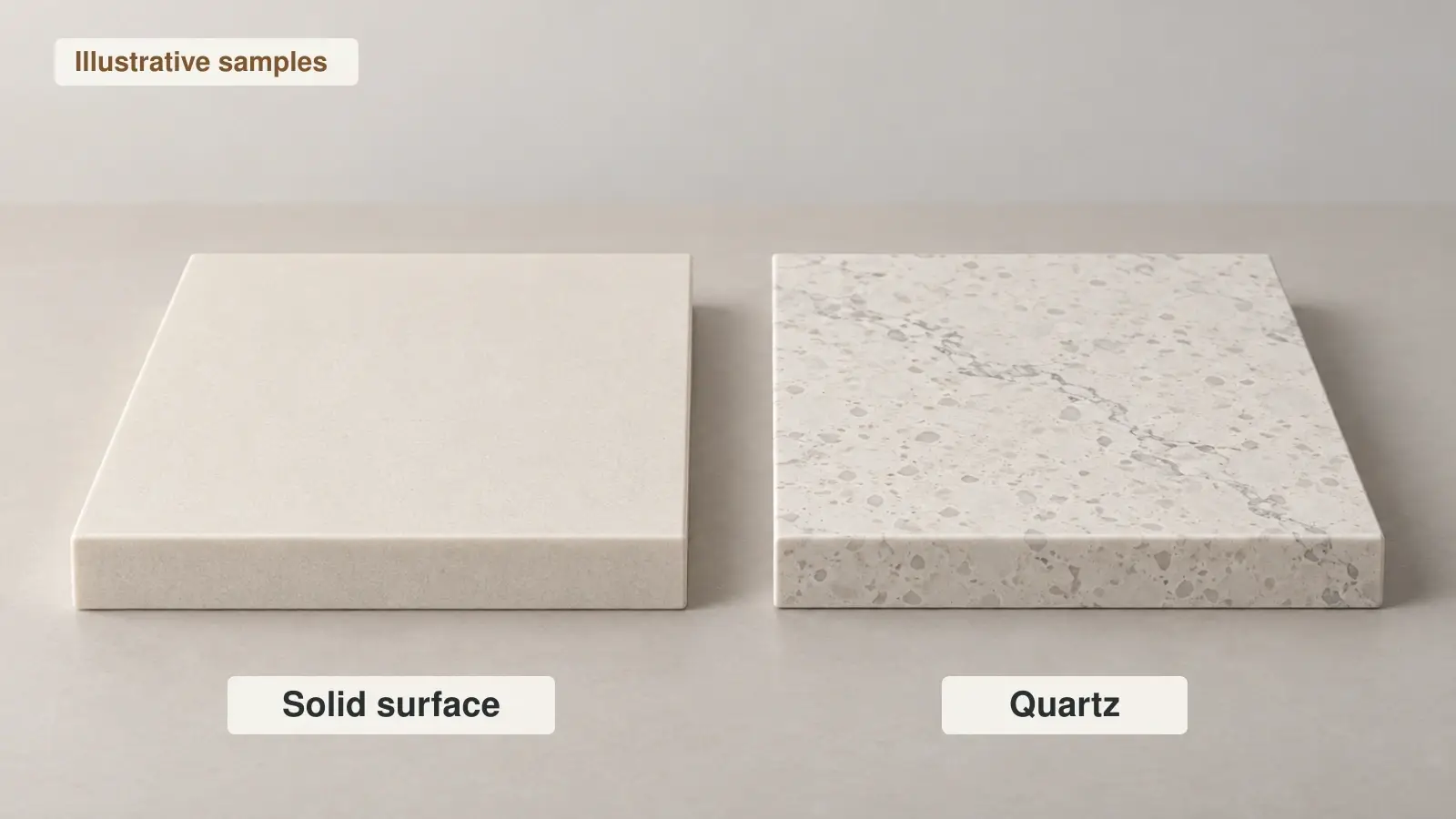
Solid surface is often the better starting point when you want inconspicuous joints, compatible integrated sink options and the ability to refinish surface marks. Quartz usually offers greater resistance to everyday scratching and a broad choice of stone-like patterns, but its seams and repairs can remain visible. Both need suitable support, careful fabrication and protection from hot cookware.
This solid surface vs quartz countertops guide focuses on seams, repairs, fabrication and the conditions in which the surface will be used. Compare the exact product and finish with your layout before choosing. Our countertop material selection guide covers the wider material shortlist.
Solid Surface vs Quartz Countertops at a Glance
| What to compare | Solid surface | Engineered quartz |
|---|---|---|
| Material | Mineral fillers with acrylic, polyester or blended resin; formulations vary | Mineral aggregate with resin and pigments; check the supplied formulation |
| Seams | Adhesive joints can be inconspicuous after matching and finishing | Joints normally remain discernible; color and pattern alignment matter |
| Surface repairs | Many marks can be professionally refinished; deeper damage needs assessment | Local chip repairs may be possible; factory finish is harder to reproduce |
| Shapes and details | Some products allow thermoforming, coved details and compatible bonded bowls | Curved outlines, edges and cutouts need product-specific slab fabrication |
| Daily use | Can show scratches; finish renewal may be a selection advantage | Generally resists ordinary scratching well; edges can still chip |
| Heat and cleaning | Use heat protection and the specified care method | Use heat protection and the specified care method |
| Installed cost | Depends on sheet yield, joints, shaping, support and installation | Depends on slab yield, pattern layout, edge work, support and installation |
Product formulations, finishes and fabrication limits vary. Here, solid surface means the resin-and-mineral material family, rather than every countertop with a solid body. Engineered quartz is also different from natural quartzite. Modern mineral-surface collections can have different compositions, so a generic quartz percentage is not a reliable specification.
Seams and Surface Continuity
Solid Surface Joints Can Be Inconspicuous
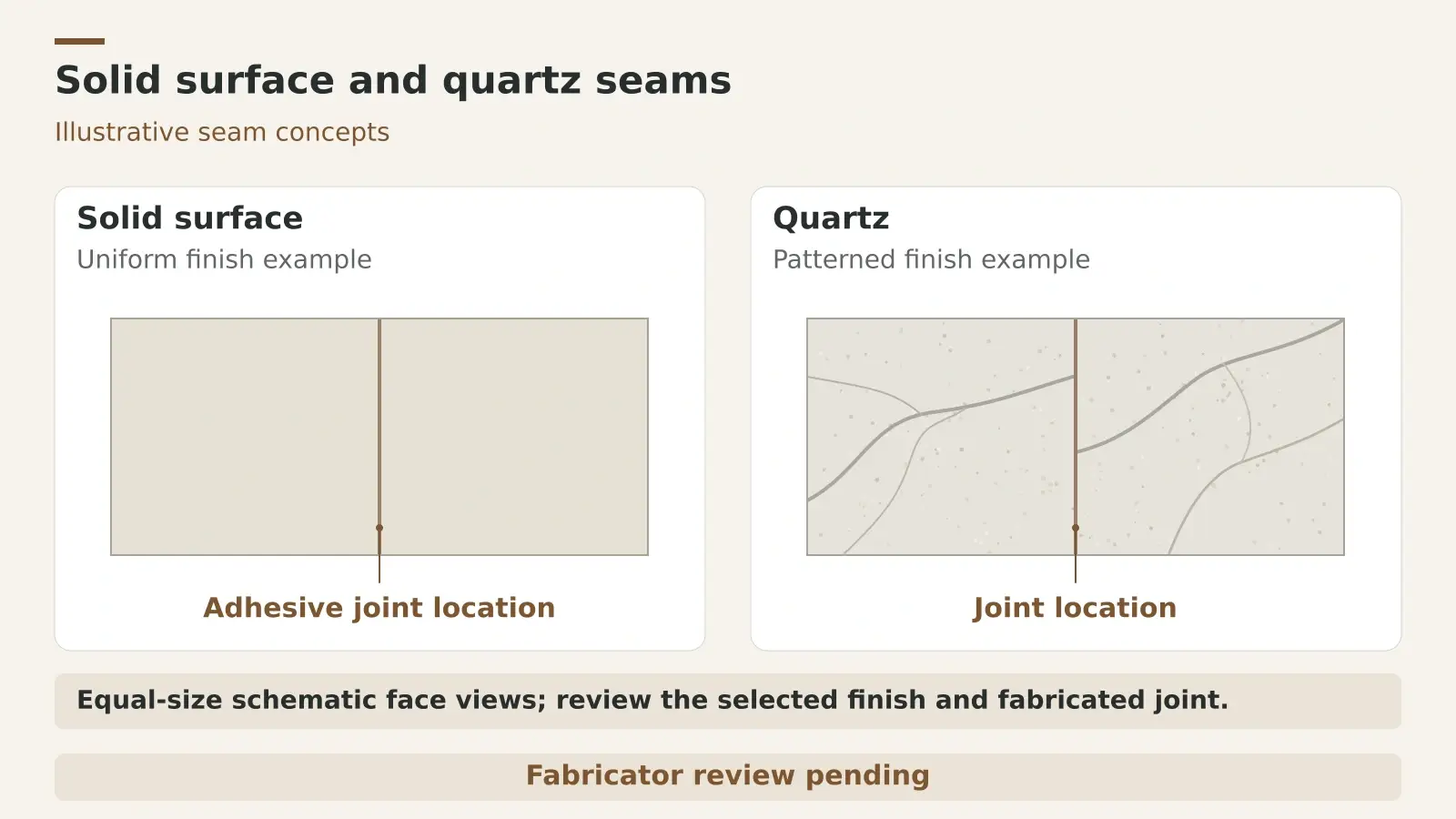
Solid surface sheets can be joined with a compatible, color-matched adhesive and finished to blend the joint with the surrounding surface. On suitable colors, a well-made seam can be difficult to notice. That result depends on the material, edge fit, adhesive, fabrication and final sheen.
An inconspicuous seam is still a bonded joint. Strong veining, large particles, metallic effects or a change in pattern direction can reveal the connection. Ask for a jointed sample in the proposed color and finish, viewed under lighting similar to the room. A small unjoined color chip cannot demonstrate the finished seam.
Quartz Seams Need a Planned Layout
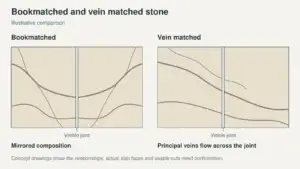
Quartz pieces are also joined with a suitable adhesive, but the joint usually remains visible to some degree. A close color match does not make the mineral particles or veining continue naturally across two pieces. A light background, directional pattern or prominent island can make layout decisions especially noticeable.
Review the actual slab allocation, pattern direction, seam positions and exposed edges before cutting. The fabricator must balance appearance with available slab size, cutouts, support and access to the room. A large slab may reduce joints in a particular layout, but it does not establish that the whole installation can be delivered or installed as one piece.
Repairs and Long Term Appearance
Solid Surface Can Often Be Refinished
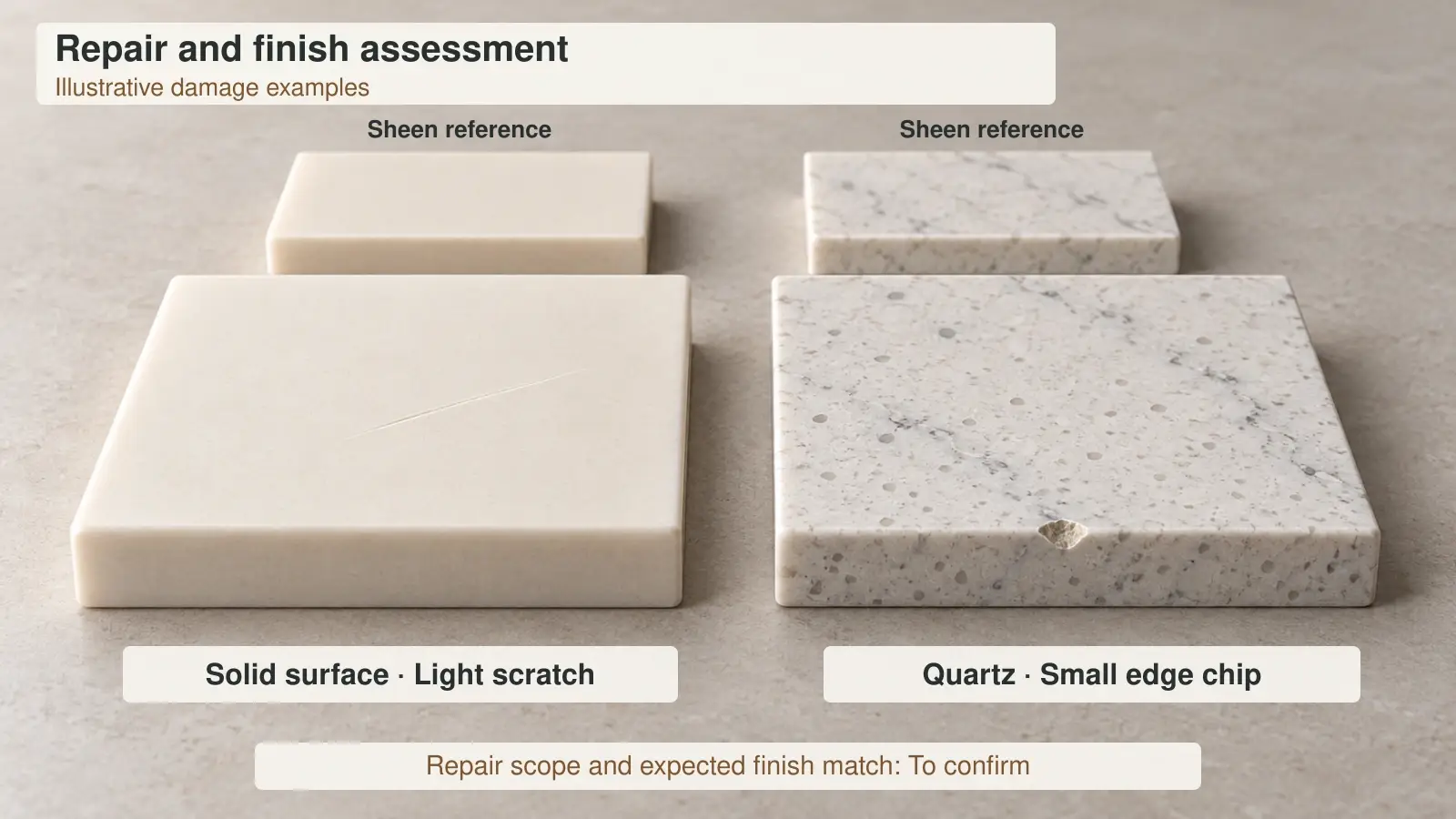
Many solid surface scratches and worn areas can be sanded and refinished using the selected manufacturer’s procedure. A qualified repairer may need to blend a wider area to achieve a consistent sheen. Dark colors and reflective finishes can make an uneven repair more noticeable.
Deeper damage may need a fitted insert, a section repair or replacement, depending on the product and condition. Heat damage, cracking and damage near a sink or cooktop require assessment. Ask whether matching material is available and what appearance the repairer can reasonably achieve; repairable does not mean every repair will be invisible.
Quartz Repairs Are Usually Localized
A specialist may be able to fill a quartz edge chip or repair a particular joint. The result depends on the location, depth, background color and pattern. A repaired edge can remain detectable, and a crack may require a different solution or replacement of a section.
Do not assume quartz can be sanded and refinished like solid surface. Abrading an installed top or seam can change the factory finish and leave a patch that reflects light differently. Contact the supplier or fabricator before attempting surface restoration. Where movement or inadequate support contributed to damage, resolve that cause as part of the repair plan.
Fabrication and Installation Details
Curves Edges and Sink Connections
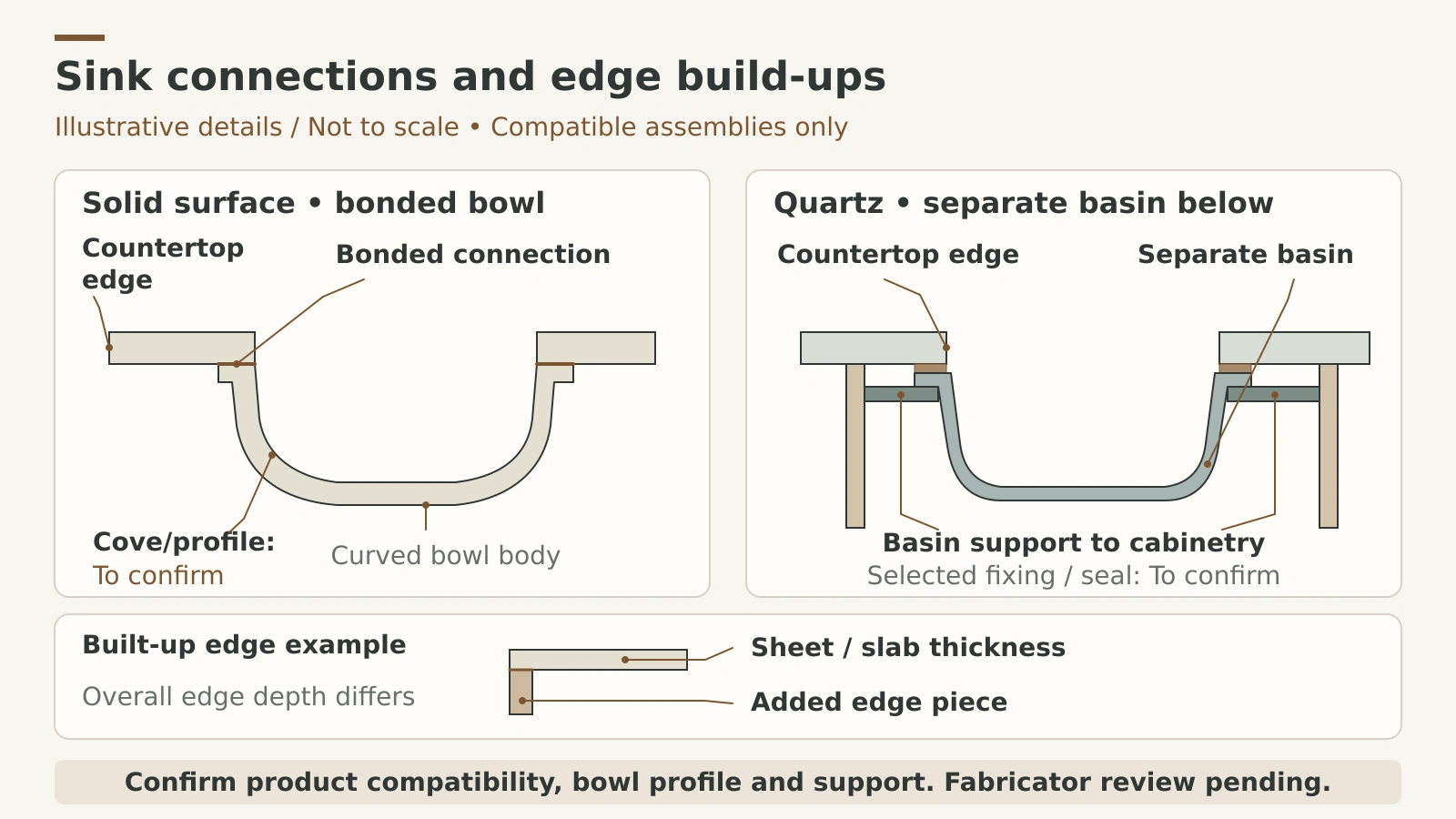
Some solid surface products can be thermoformed into approved shapes. Suitability depends on the formulation, color, thickness and intended geometry. Thermoforming changes the shape of suitable material; joining sheets with adhesive is a separate operation. Confirm the proposed detail with the actual product’s fabricator.
Quartz curved outlines and shaped edges are normally produced by cutting and finishing the slab. A thick-looking edge may be built from joined pieces rather than one full-depth slab. Approve a section showing the material thickness, buildup and exposed edge, especially where the pattern changes at a miter or waterfall.
Compatible solid surface bowls and coved backsplashes can create a visually continuous transition. Other sink materials or mounting types need their own connection details. Quartz tops commonly use a separately mounted basin. Compare sink mounting, cutouts and support before approving the opening; the countertop material alone does not define the mounting system.
Cutouts Support and Site Access
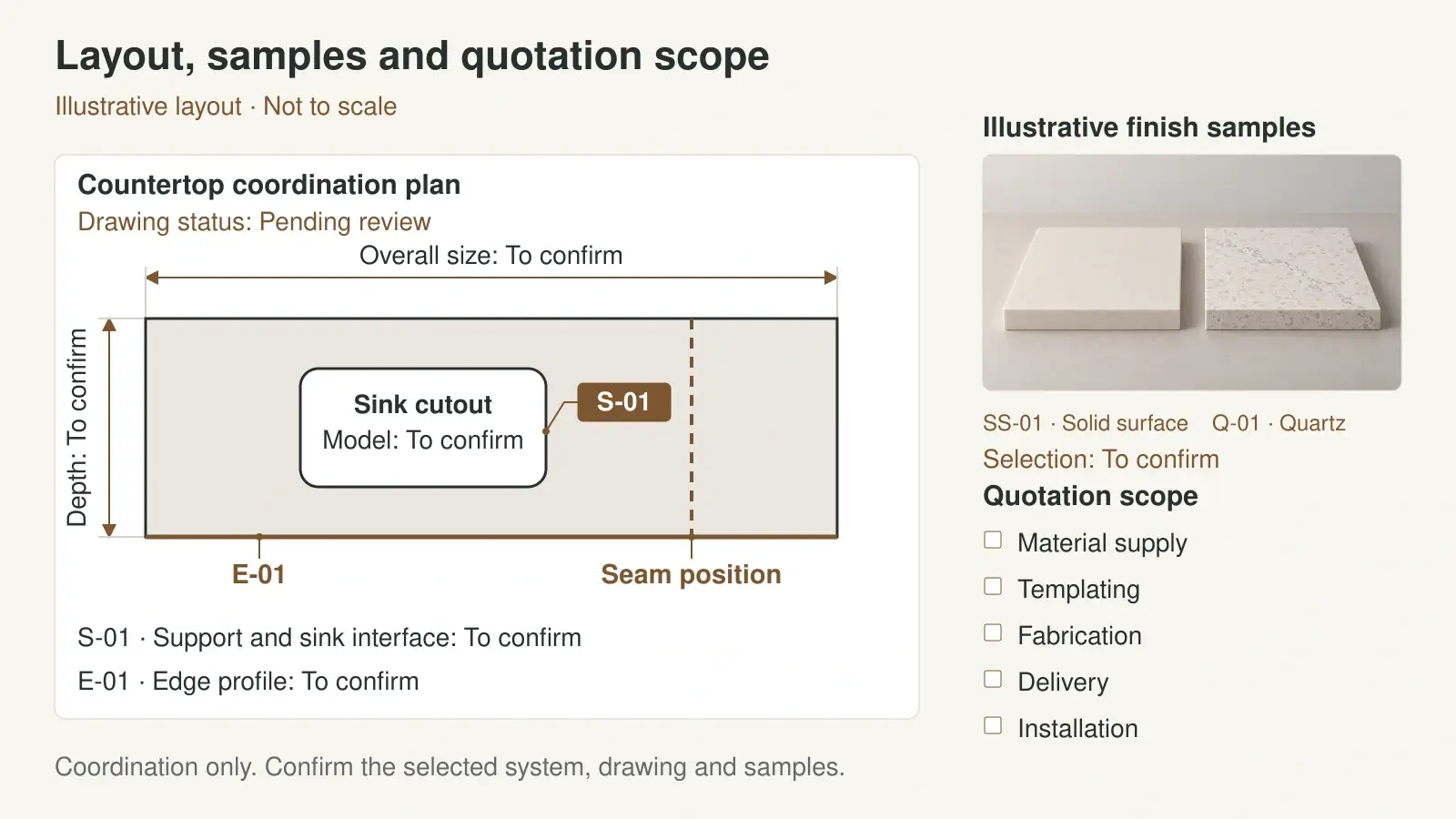
Both materials need a coordinated installation drawing. Show the exact sink and appliance models, cutouts, corner details, joints, overhangs and support. Use the selected manufacturer’s fabrication rules rather than transferring one material’s minimum dimensions or support spacing to the other.
Check that cabinets are ready to receive the top and that the installation sequence allows access for sink supports, services and fixings. Our cabinet and worktop coordination guide connects these interfaces. Also confirm the delivery route, lift or stair access and piece sizes before deciding where site joints will be made.
Agree on Controlled Fabrication and Site Adjustments
Define which cutting, drilling and finishing will be completed in the workshop and what, if anything, remains for site. Machining silica-containing engineered stone can release hazardous respirable crystalline silica. The fabricator should assess the exact product’s safety data and use appropriate dust controls and work practices; a lower-silica label alone does not establish a safe process.
Solid surface fabrication also needs product-specific dust control and adhesive safety measures. Include responsibility for any site adjustment in the quotation. This is a reason to use a competent fabrication team and confirmed templates, rather than plan uncontrolled cutting during installation.
Conditions for Everyday Use
Scratches Cleaning and Heat
Quartz is often shortlisted for a busy kitchen because of its resistance to ordinary scratching. Solid surface can suit a kitchen where future refinishing and integrated details matter more. Use cutting boards with both materials, and avoid impacts at vulnerable edges or around cutouts.
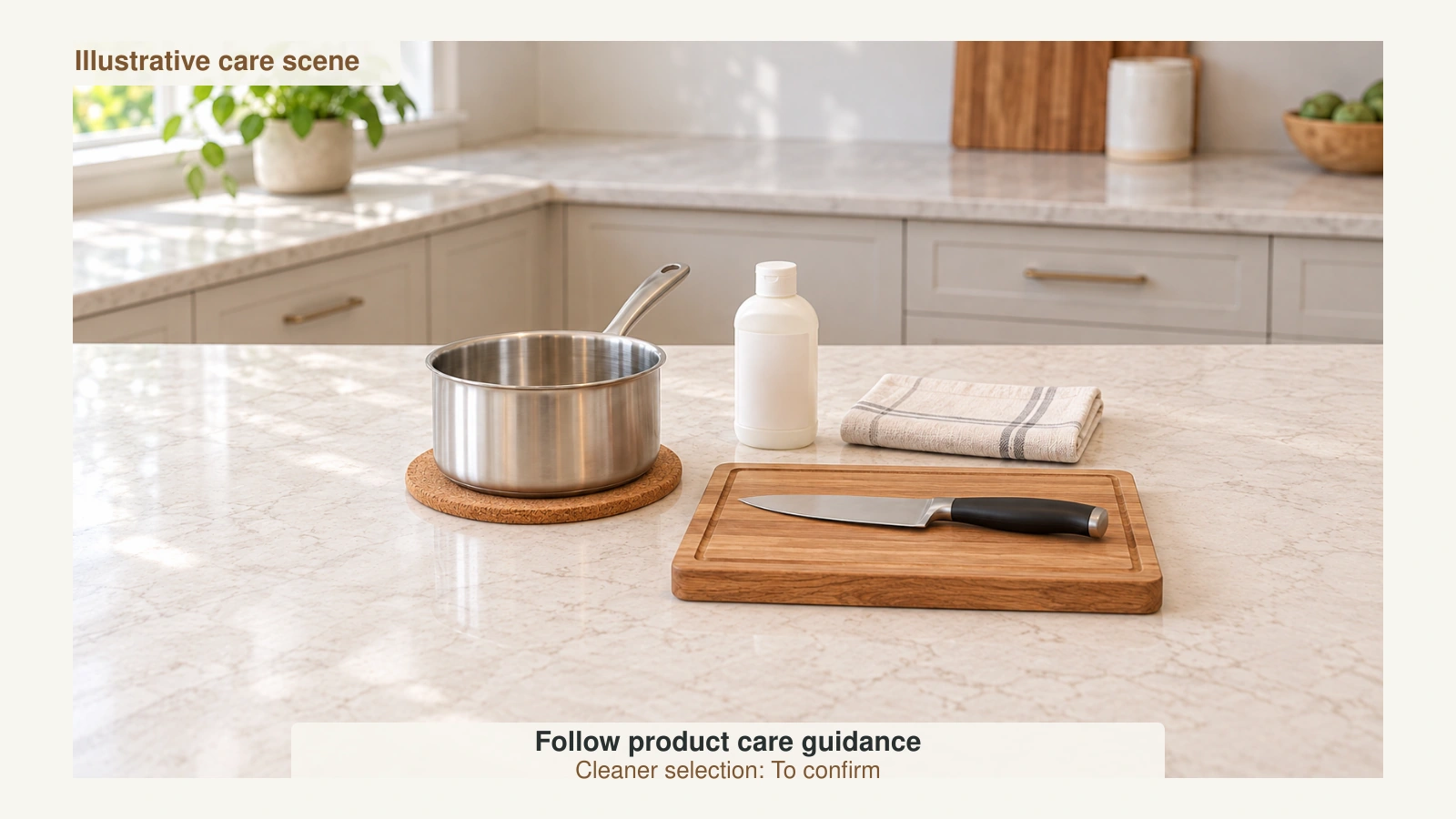
Neither is a heatproof landing area for cookware. Use the heat protection required by the product’s care instructions, and coordinate cooktops and portable heat-generating appliances with their installation guidance. An assumed temperature limit is less useful than knowing how the proposed assembly should be used.
Neither material normally needs routine surface sealing. Start daily cleaning with the manufacturer’s recommended mild method, remove spills promptly and dry away residue. Check the actual finish before using abrasive pads, solvents, strong cleaners or a refinishing product. Honed, textured, dark and glossy surfaces can show use differently.
Vanities Utility Areas and Outdoor Locations
For a vanity, consider basin integration, faucet holes, splashes, cosmetics and cleaning products. A nonporous top still needs properly detailed wall and sink connections. Our vanity top measurements and fabrication details guide covers that assembly. In a utility room, identify the chemicals, appliances and other exposures before selecting a surface.
Do not assume an indoor product is approved outdoors. Dedicated outdoor quartz products exist, while solid surface exterior suitability can depend on the exact product, color and application. Obtain written confirmation for the complete countertop assembly, including joints, support and exposure. An exterior cladding approval does not by itself establish suitability for a horizontal kitchen top.
If sunlight or exterior use is central to the brief, expand the shortlist with our sintered stone vs quartz comparison. Verify each proposed product’s outdoor use and care conditions rather than choosing from a material name alone.
Compare Complete Countertop Quotations
Solid surface can cost less than some quartz selections, but there is no dependable price ranking for every installation. A shaped solid surface counter with bonded bowls and coved details may involve substantial labor. A quartz quotation can change with the pattern, slab yield, edge fabrication and number of cutouts.
Ask suppliers to price the same dimensions and scope. Include the actual material code and finish, material thickness and edge buildup, seam plan, sink model, cutouts, supports, templating, delivery, installation and disposal where required. Identify exclusions and any unresolved dimensions. Keep the product, color, sample and review references in the finish codes and sample review records.
Before approving fabrication, review a jointed sample and the proposed drawing together. Confirm who supplies the sink supports, performs final measurements and records any changes. Keep the care instructions, repair contact and applicable warranty terms with the handover information.
George House Material supports shop drawing and material sample coordination within the agreed procurement scope. Final selection, dimensions and approval remain with the client or appointed project consultant. To discuss the package, send your countertop layout for review with the surface references, sink and appliance data, delivery location and any pending decisions.
Frequently Asked Questions
Are Solid Surface Countertop Seams Invisible
They can be inconspicuous on suitable colors when properly fabricated and finished. Pattern changes, particles, sheen and lighting can still reveal them. Approve a jointed sample rather than relying on a promise of an invisible seam.
Can Quartz Countertops Be Repaired
Some chips or joints can receive a specialist repair, but the result may remain visible. Cracks and larger damage need assessment of the material and its support. Do not treat quartz as a surface that can be routinely sanded and renewed in the same way as solid surface.
Which Countertop Is Cheaper to Install
Compare itemized quotations for the same layout. Material choice, sheet or slab yield, seams, edge work, cutouts, site access and installation can outweigh a simple comparison of price per unit area.