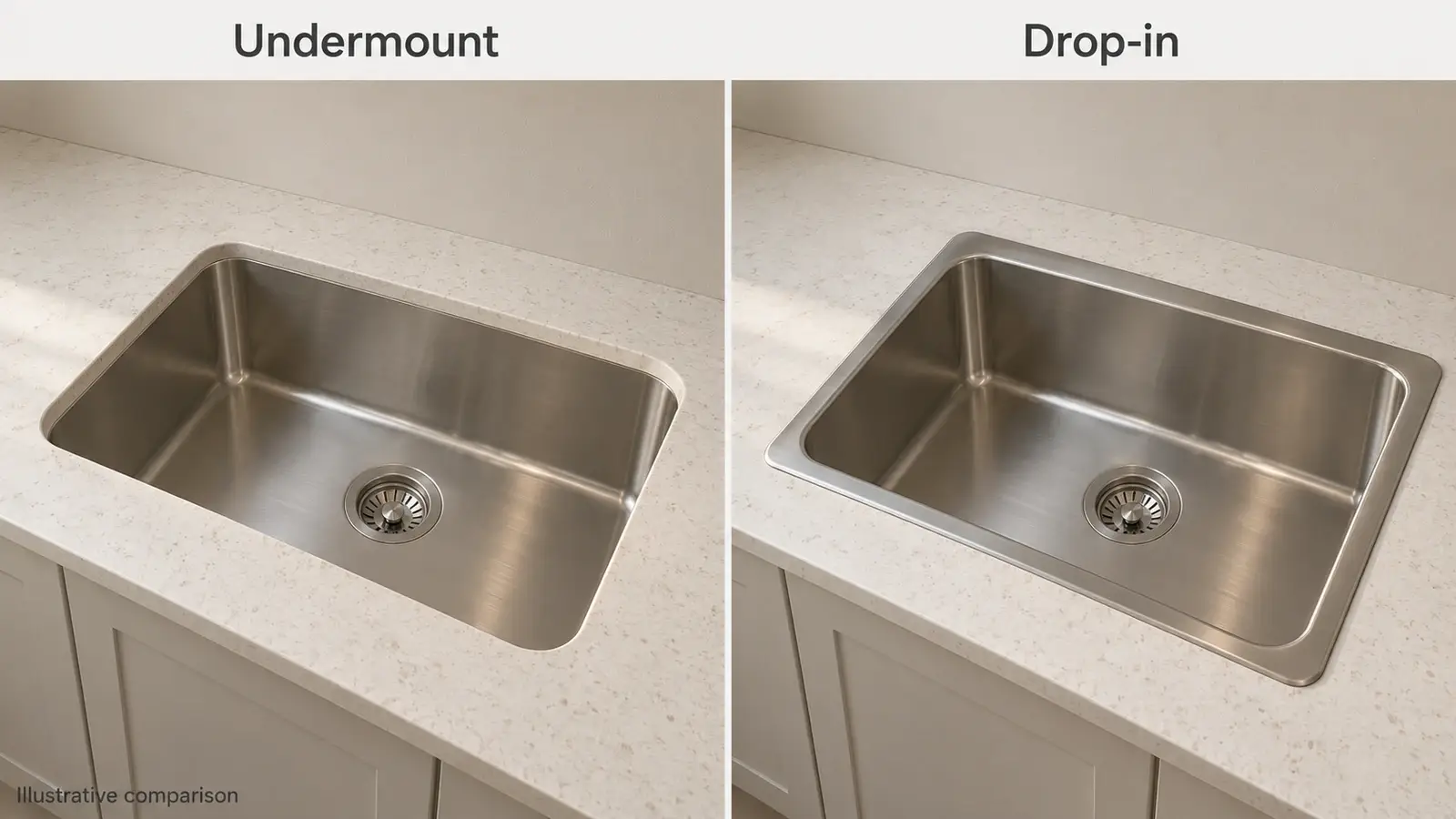
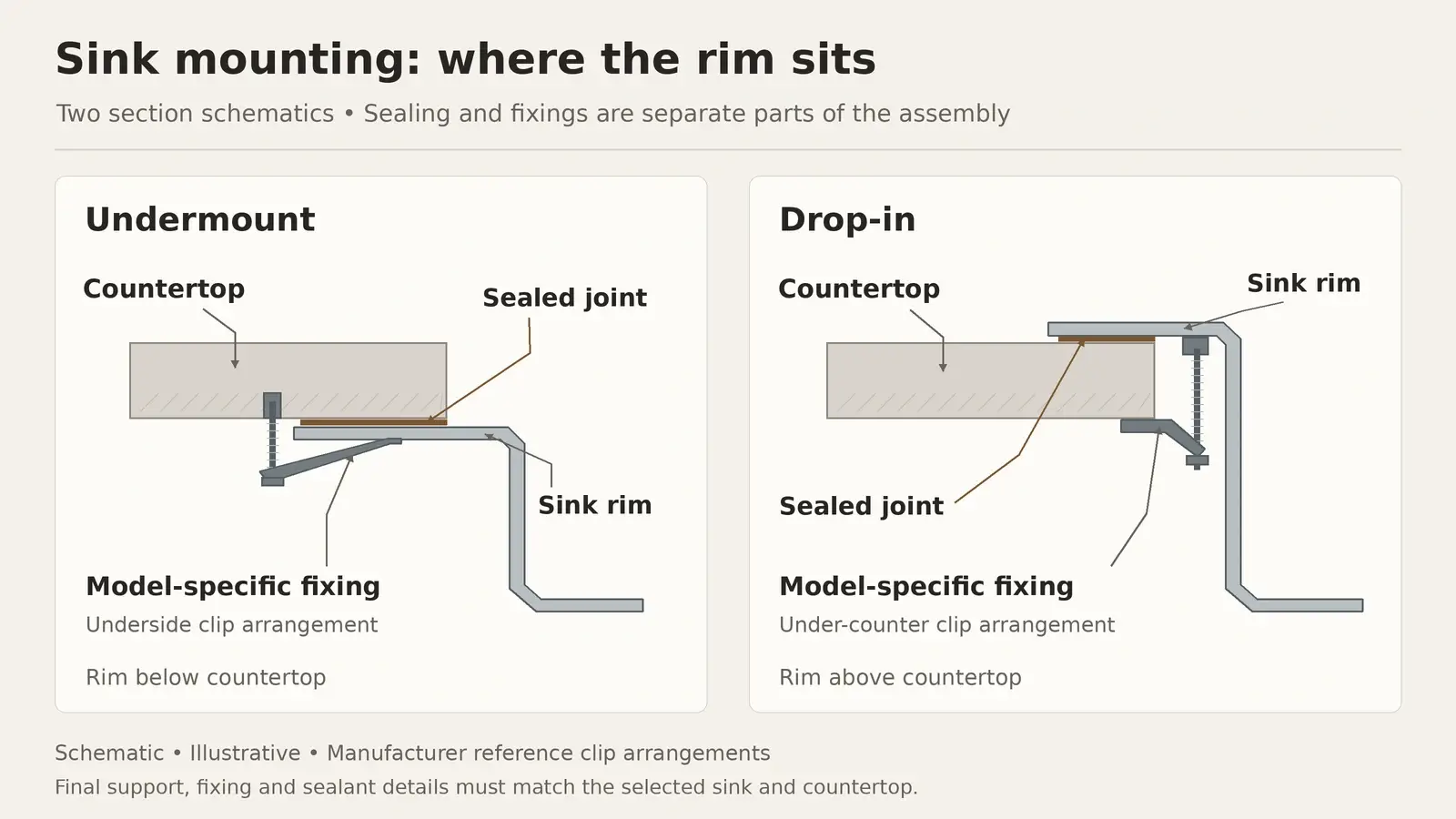
The main difference between an undermount and a drop-in sink is where the rim sits. An undermount sink attaches below the countertop, leaving the counter edge visible around the bowl. A drop-in sink fits through the opening from above, with a rim that overlaps the countertop.
Choose undermount when you want to wipe the counter directly into the basin and the countertop can accommodate the approved installation. Choose drop-in when a visible rim suits your design or a compatible model lets you retain an existing countertop. For either option, check the sink model, cutout, cabinet space and installation scope before ordering.
Undermount vs Drop In Sink at a Glance
| Detail | Undermount sink | Drop-in sink |
|---|---|---|
| Position | Rim below the countertop. | Rim rests above the countertop. |
| Appearance | Countertop cut edge remains visible. | Sink rim covers the cut edge. |
| Counter cleanup | No raised rim blocks wiping debris into the bowl. | Wipe around the rim and its sealed perimeter. |
| Countertop compatibility | Requires an approved material, cutout and mounting system. | Works with many surfaces when the rim, cutout and fixing method suit them. |
| Installation | Needs specified support beneath the counter and a sealed joint. | Needs a flat seating surface, perimeter seal and specified fixings. |
| Replacement | Check access to release supports and remove the basin from below. | Often simpler if the new bowl fits and the rim covers the existing opening. |
| Project cost | May include exposed-edge finishing and additional support. | May involve less countertop work when replacing a matching model. |
Mounting type does not determine bowl size, material quality or service life. Compare equivalent sink specifications and the work included in each quote.
Undermount Sink Pros and Cons
Advantages of an Undermount Sink
The main practical benefit is the counter-to-bowl transition. You can wipe crumbs toward the basin without working around a rim on top of the counter. The exposed countertop edge also gives the sink area a continuous appearance.
Undermount installation leaves more of the worktop visible around the opening. The useful preparation space still depends on the sink footprint, nearby appliances and overall layout; mounting type alone does not guarantee a larger working area.
Limitations of an Undermount Sink
The cut edge needs appropriate fabrication, and the mounting system must support the selected sink. The joint below the counter still needs cleaning and inspection. An undermount sink is not a joint-free or maintenance-free installation.
Confirm compatibility before buying the sink. A countertop that looks suitable in a photograph may have an unsuitable thickness, damaged cutout or insufficient space for the required supports.
Drop In Sink Pros and Cons
Advantages of a Drop In Sink
A drop-in sink is also called a top-mount or self-rimming sink. Its rim covers the cut edge, which can be useful when keeping an existing counter. If the opening, cabinet and plumbing already suit the replacement, the work may be relatively limited.
Drop-in models are commonly considered for laminate countertops. The covered edge still needs the specified moisture protection and seal. A rim should not be used to conceal a swollen substrate or an opening that is too large to support the sink properly.
Limitations of a Drop In Sink
The visible rim interrupts the work surface and adds an edge to clean around. Its effect varies with the rim profile; some models sit much closer to the counter than others.
The rim must seat evenly on a sound surface. Check the fixing access below the countertop, as well as any faucet holes on the sink deck. A similar nominal sink size does not establish that two models are interchangeable.
Countertop Compatibility
Stone and Solid Surface Countertops
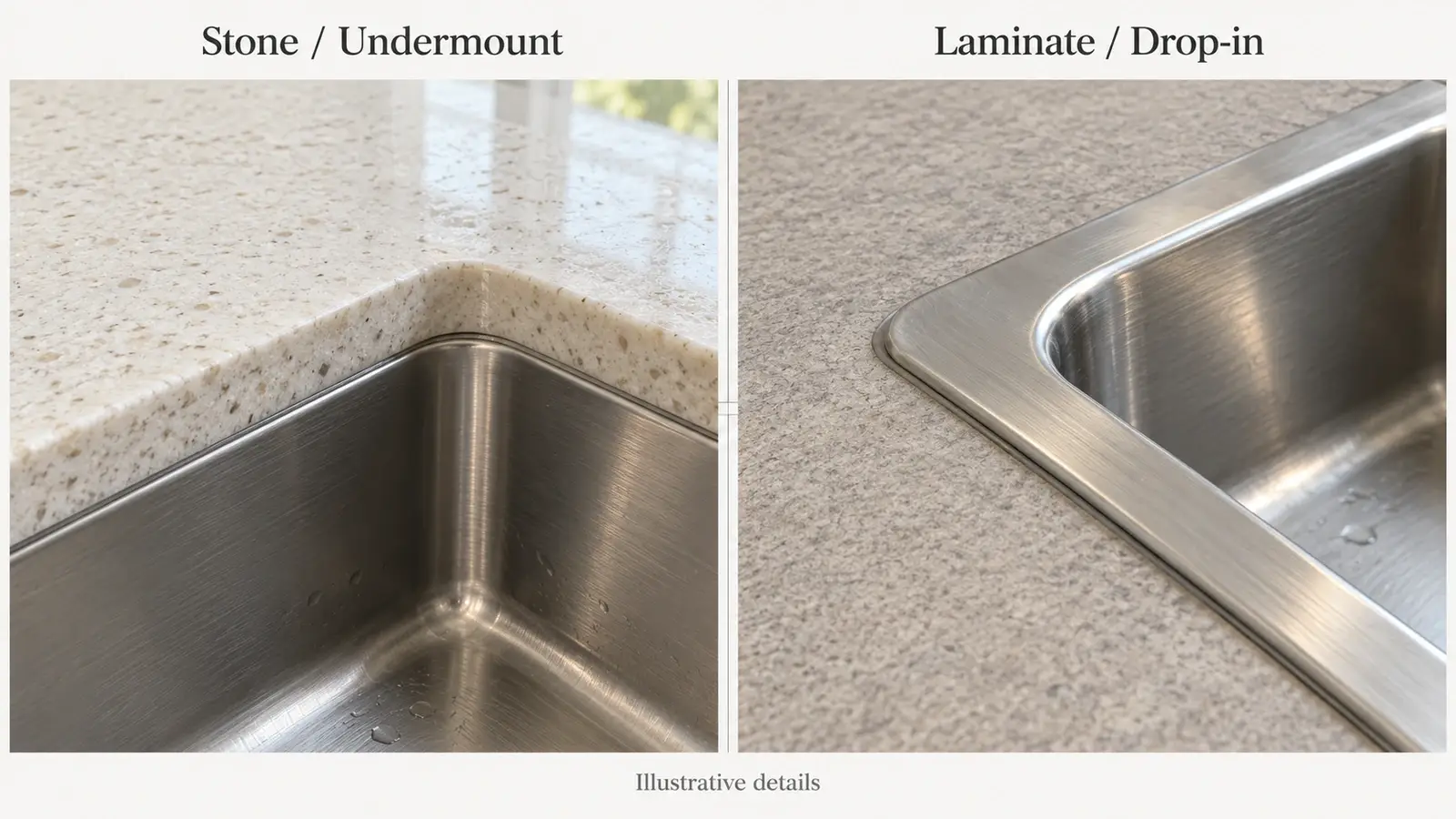
Granite, engineered quartz and solid surface are common candidates for undermount installation, subject to the product and fabricator's approval. Review the thickness, cutout shape, edge finish and support requirements together. Natural stone and manufactured surfaces have different fabrication and care requirements.
Use the countertop material comparison to narrow the surface options, then confirm the selected sink installation with the fabricator. For a coordinated surface package, review countertop cutouts and support details before fabrication.
Laminate and Other Moisture Sensitive Countertops
A conventional laminate countertop often suits a drop-in sink because the rim covers the opening. The cut substrate and all relevant joints still require protection according to the countertop and sink instructions.
Undermount installation on laminate is possible with specifically approved systems. Formica identifies purpose-designed Karran options for this application. That exception does not make a generic undermount basin suitable for a standard laminate cutout. Confirm the exact sink, countertop assembly and installation method rather than adapting a stone-countertop detail.
For timber or another moisture-sensitive surface, ask the supplier how the opening and joint will be protected and maintained. Neither mounting style removes the need to check material compatibility.
Undermount Sink Reveal Options
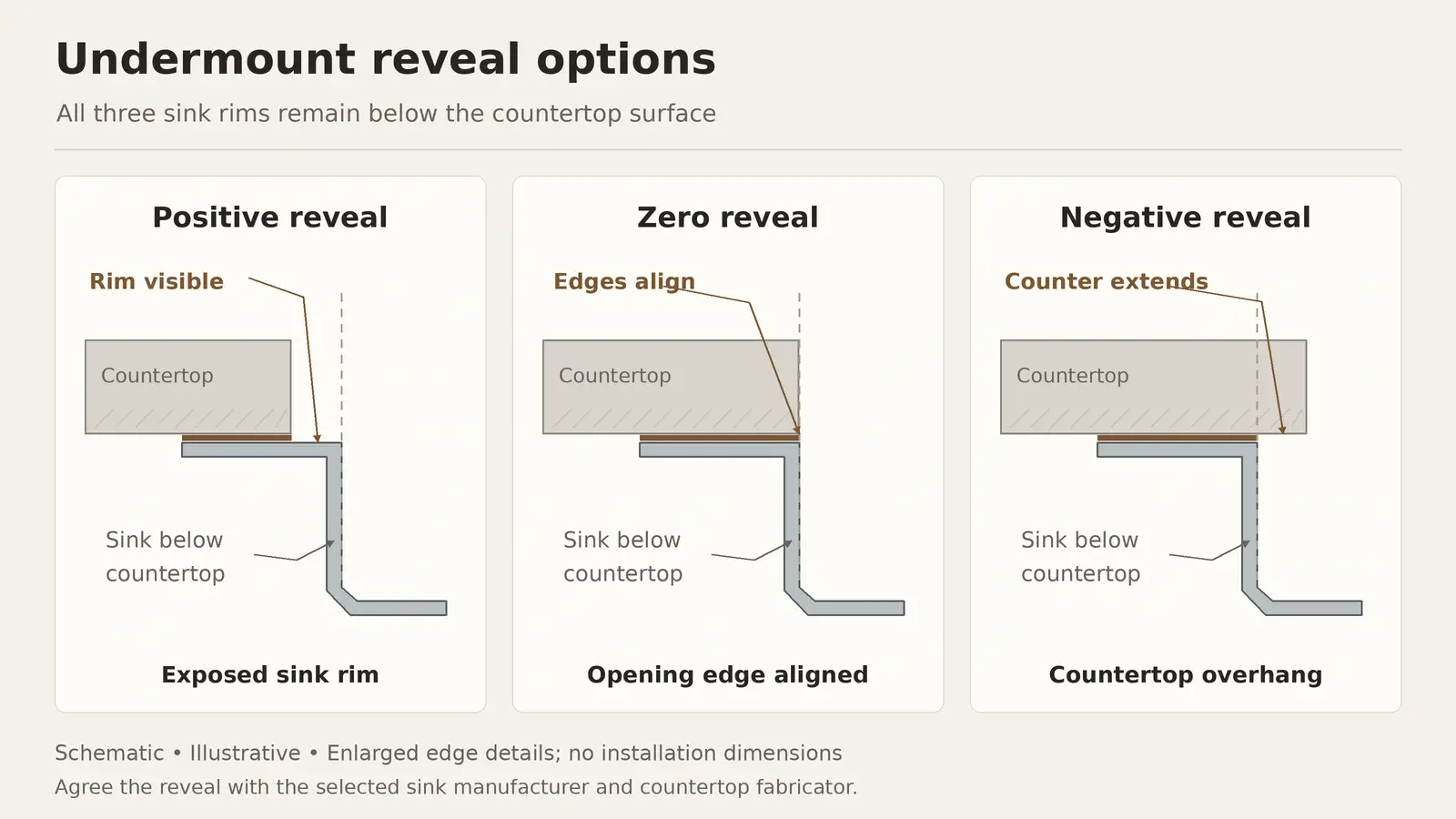
The reveal describes the relationship between the countertop opening and the edge of the sink bowl. Agree the intended detail before the countertop is cut.
- A positive reveal exposes a strip of the sink rim inside the countertop opening.
- A zero reveal aligns the counter edge approximately with the bowl edge.
- A negative reveal lets the countertop overhang part of the bowl opening.
A zero reveal is different from a flush-mount sink installed level with the top surface of the counter. Check which reveals the actual sink supports, particularly for workstation models whose accessories depend on the opening. Record the approved detail on the fabrication drawing; do not assume every supplied template shows the same reveal.
Installation and Cabinet Fit
Separate Structural Support From Sealing
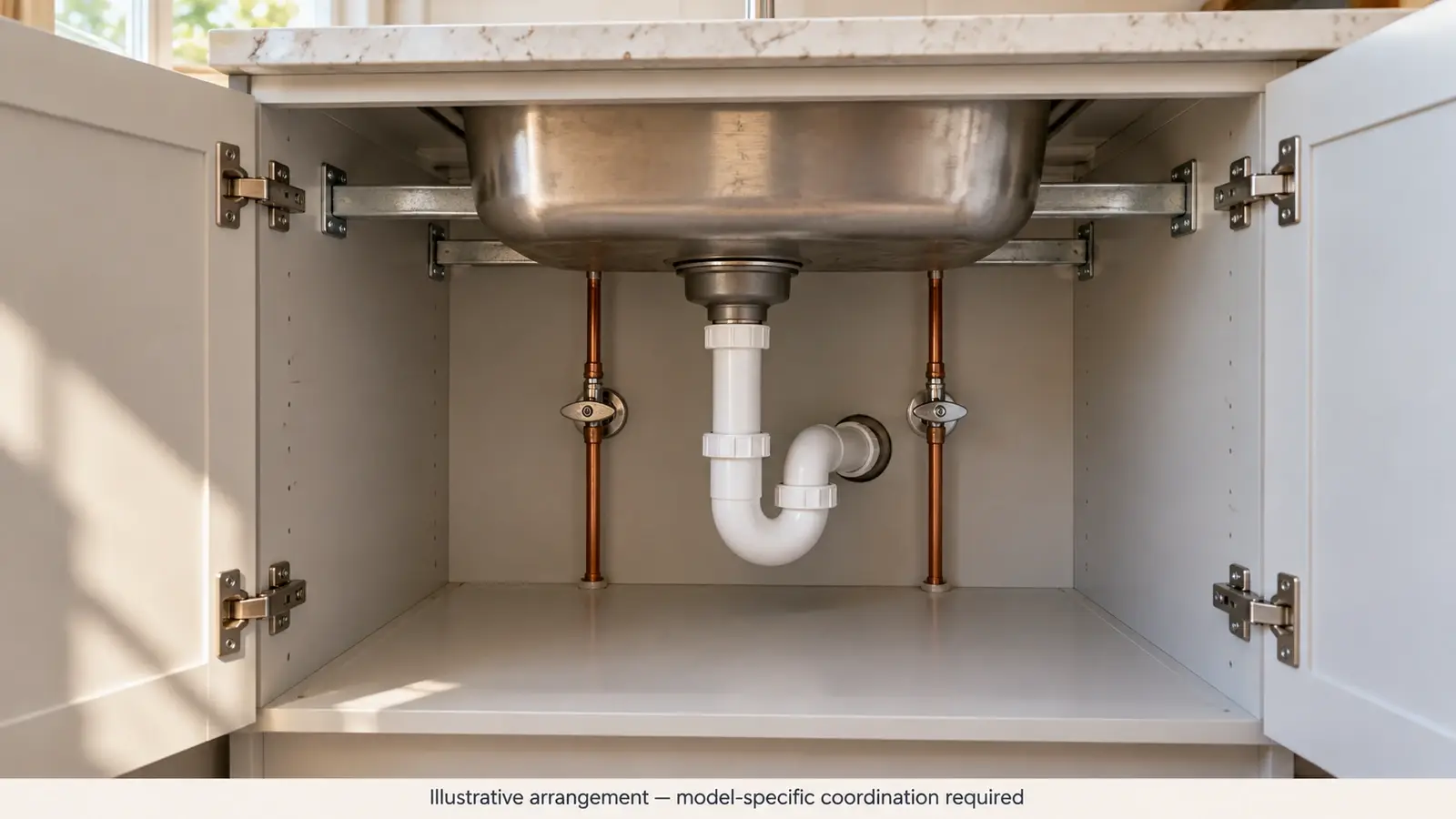
An undermount installation needs the support arrangement specified for the model and countertop. This may use mounting clips, brackets, rails or a frame attached to the cabinet. Heavy sinks can require a different arrangement from lighter models.
Sealant closes the joint; ordinary silicone sealant should not be treated as a universal replacement for the required support. Follow the specified surface preparation and curing instructions. A drop-in sink also needs its approved fixings and a sound perimeter seal, even though its rim rests above the counter.
Check the Space Below and Behind the Sink
Check the manufacturer's minimum cabinet requirement and the actual internal space. Allow for the bowl, mounting hardware, drain assembly, pipes and any disposal or accessories. Confirm that cabinet partitions, drawers and services will not obstruct installation or maintenance.
Check faucet position, handle movement, backsplash clearance and countertop thickness. A deep bowl can change the drain connection and usable cabinet space. Review kitchen cabinet and countertop coordination with the sink model and plumbing information together.
Cleaning and Long Term Maintenance
Clean the Edge and Joint
With an undermount sink, clean beneath the counter edge as well as the visible bowl. Food residue and moisture can remain at the joint even though the counter is easy to wipe. With a drop-in sink, clean the rim and the seam where it meets the worktop.
Use cleaning products approved for both the sink and countertop. Material and finish affect care requirements, so mounting type alone does not establish which sink is more durable or hygienic.
Investigate Moisture or Movement
Check the cabinet for recurring dampness and inspect the perimeter for gaps or separating sealant. Water may come from the sink joint, faucet, drain or another connection. Find the source before resealing.
If the basin moves or the joint repeatedly opens, have the mounting system checked. Follow product care guidance and respond to the condition of the installation rather than assuming every seal needs replacement on a fixed schedule.
Sink Costs and Replacement
Compare the Complete Installation Scope
There is no dependable price difference that applies to every undermount and drop-in sink. Sink material, bowl configuration, accessories and local installation conditions all affect the total.
Request separate allowances for the sink, removal, cutout work, exposed-edge finishing, supports, sealing, plumbing adjustments and any countertop or cabinet repairs. A matching drop-in replacement may need less fabrication than a change to undermount, but compare the actual scope before deciding which project costs less.
Can You Change From Drop In to Undermount
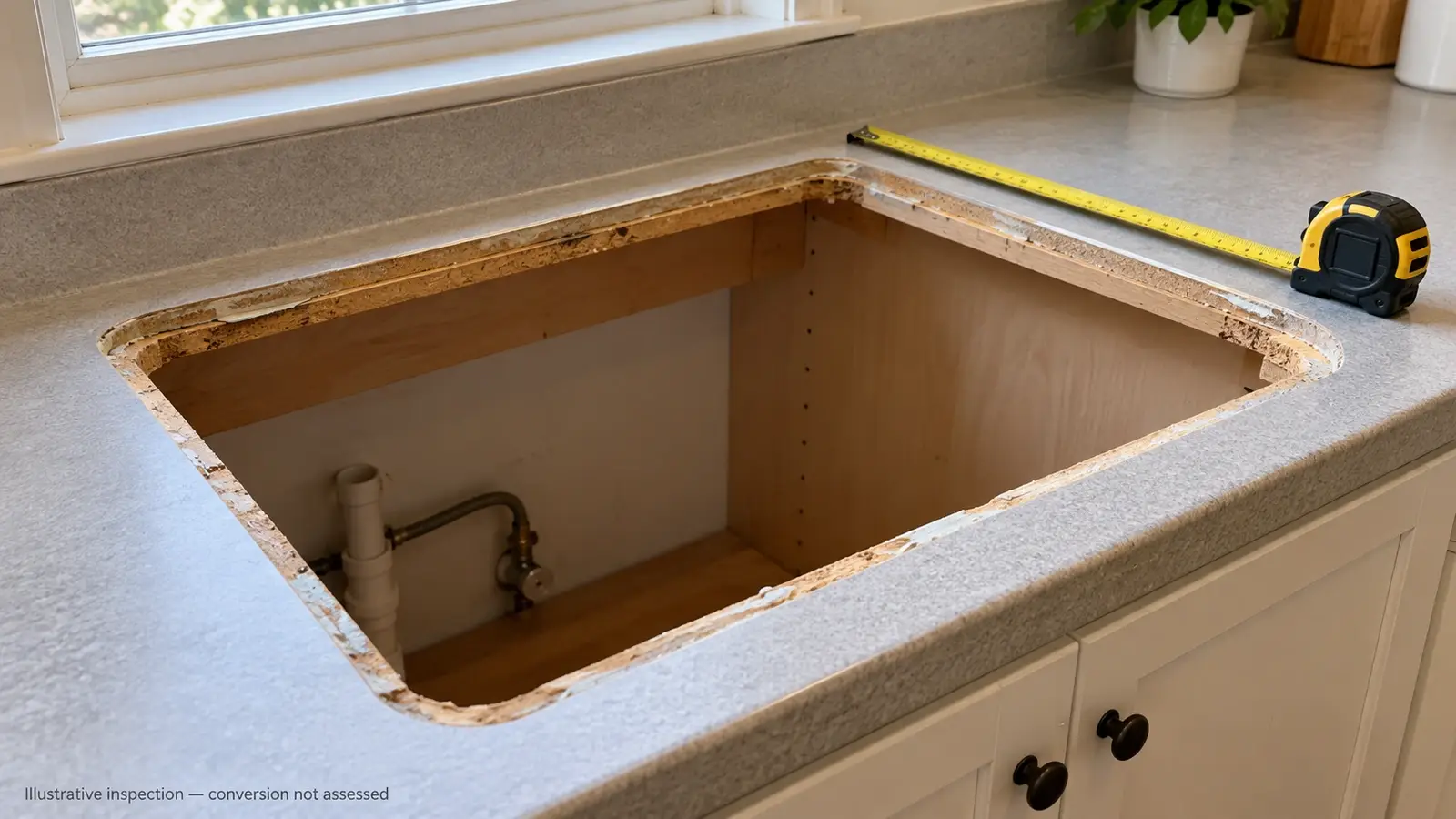
Sometimes, but the existing opening must suit an undermount installation. The old drop-in rim may hide a rough edge, chipped material or a larger cutout than the proposed sink can accommodate. Corner shapes and faucet holes can also limit the conversion.
Have the fabricator assess whether the opening can be finished and supported or whether the countertop needs replacement. Plan access for future removal as well. An undermount basin does not automatically require removing the whole countertop to replace it; that depends on the assembly and access below.
Only use a sink in both mounting configurations when the manufacturer approves it as dual-mount. A conventional drop-in sink is not automatically an undermount model.
Which Sink Should You Choose
For a New Kitchen
Undermount is a useful option when the chosen countertop and fabrication plan support it and easy counter wiping matters to you. Coordinate the basin with the sink-base cabinet before manufacturing. Review the available custom cabinetry and worktop interfaces alongside the countertop detail.
For an Existing Countertop
A compatible drop-in replacement is often a practical starting point when retaining the counter is the priority. Measure the existing opening and inspect its condition. Compare any change in bowl depth, deck holes and drain location before assuming the replacement will be simple.
For a Kitchen Island
Both mounting styles can work in an island. Sink position, preparation space, faucet movement, seating and service access may matter more than the rim detail. Use the guide to planning a kitchen island with a sink before freezing the layout.
What to Confirm Before Ordering
- Exact sink model, approved mounting type and bowl configuration.
- Countertop material and thickness, cutout template, corner shape and edge detail.
- Agreed undermount reveal, where applicable.
- Sink-base cabinet dimensions and space for supports, drains and services.
- Faucet and accessory holes, handle clearance and plumbing connections.
- Installation responsibilities, support method, sealing products and maintenance access.
- Quotation scope, including removal, fabrication and any repairs.
Approve the sink model and coordinated drawing before cutting the countertop. Use the model-specific template or CAD file and verify it against the actual sink and approved reveal before cutting. For a project package, agree the scope of shop drawing and material sample coordination and who authorizes fabrication.
Get Help Coordinating Your Kitchen Package
To discuss a coordinated material package with George House Material, send your sink model and kitchen drawings with the countertop reference, cabinet layout and available site dimensions. Ask the team to confirm the available supply scope and identify the information needed to coordinate the sink, counter and cabinetry.
Frequently Asked Questions
Is an Undermount Sink Better Than a Drop In Sink
It is better suited to easy counter wiping and a visible finished countertop edge. Drop-in can suit a compatible replacement or a surface that needs its cut edge covered. The countertop and installation conditions should guide the choice.
Can You Use an Undermount Sink With Laminate
Yes, with a purpose-designed sink and an approved laminate installation system. This does not mean any undermount sink can be fitted to an ordinary laminate countertop. Check the specific combination with the manufacturer and fabricator.
Which Sink Is Easier to Clean
Undermount makes it easier to wipe debris directly from the counter into the basin. Its underside joint still needs cleaning. Drop-in requires attention around the top rim and seal, so neither style is maintenance-free.
Can You Replace a Drop In Sink With an Undermount Sink
Only if the countertop, opening, finished edge and support arrangement suit the new installation. An existing rim may hide damage or an unsuitable cutout. Have the fabricator assess the work before buying the replacement.
Does an Undermount Sink Need Support Below the Counter
It needs the support system specified for the sink and countertop. Depending on the model, that may involve clips, brackets, rails or a cabinet frame. Ordinary silicone sealant alone is not a general support specification.
Are Undermount Sinks More Expensive
They may need additional fabrication or support, but price depends on the complete sink and installation package. Compare equivalent specifications and itemized scopes rather than assuming the mounting style determines the cost.