Blackout curtains are intended to stop light passing through the fabric or lining. Dimout curtains reduce light transmission, with the remaining light depending on the selected fabric and colour. Some dimout fabrics still darken a room considerably, so the product name alone does not tell you how bright the room will remain.
When comparing blackout vs dimout curtains, review the complete installation as well as the cloth. Fabric layers, lining, curtain coverage and the track arrangement all affect the result. Start with the room’s required light level, then coordinate the selected materials through our curtain and soft furnishing coordination guide.

Blackout vs Dimout Curtains at a Glance
| Selection point | Blackout curtains | Dimout curtains |
|---|---|---|
| Light through the material | Intended to stop transmission through the specified fabric or lining | Reduces transmission; the amount varies with the product and colour |
| Construction | May use a woven structure, coating, internal layer or separate blackout lining | Often uses a dense woven construction; confirm the actual layers and finish |
| Room goal | Useful when very low daylight is a priority | Useful when some transmission is acceptable; check how dark the chosen fabric becomes |
| Edge gaps | Require a separate installation review | Require a separate installation review |
| Ordering basis | Named fabric, colour, lining and verified installation details | Named fabric, colour, light-control data and verified installation details |
Neither label guarantees complete darkness throughout an installed room. Silent Gliss explains the distinction between fabric transmission and light entering around a standard curtain system. Request technical information for the exact fabric and colour, including the test method behind any stated result.
Check the Fabric Layers and Lining
Identify the Construction Behind the Label
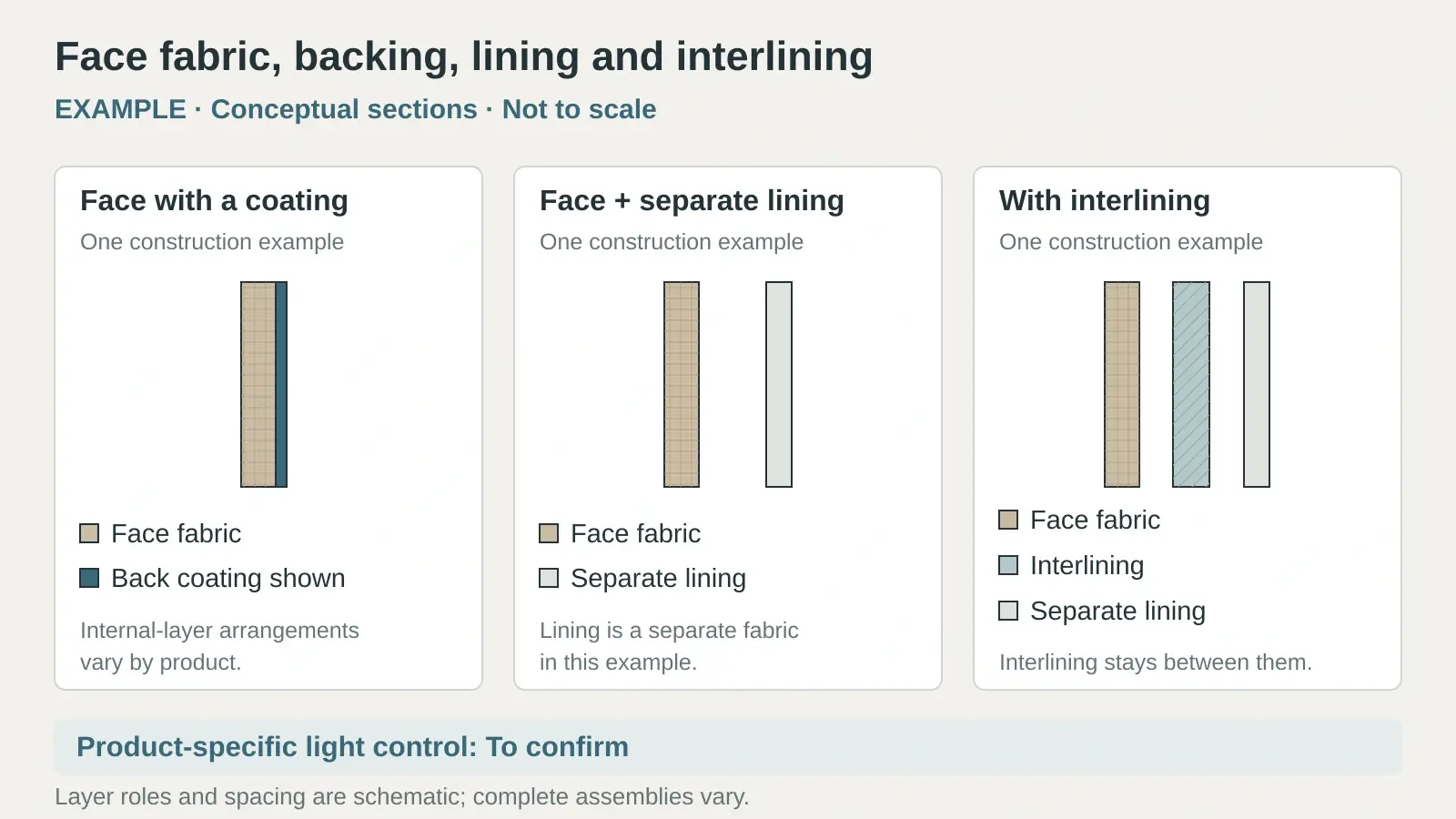
The face fabric is the visible decorative cloth. A backing or coating is applied to, or incorporated within, the fabric construction. A lining is a separate cloth behind the face; interlining is an additional layer between face and lining. Confirm which layers are actually included in the quotation.
Blackout does not always mean a coated fabric. For example, Kvadrat’s Tonight woven blackout achieves its light-blocking construction without an added coating. Conversely, a dark yarn inside a woven fabric does not automatically establish blackout performance: Kvadrat describes Twilight as a dimout fabric. These are product examples, not specifications for every woven curtain.
Colour and fabric weight can help describe appearance and handling, but cannot replace light-transmission data. Also distinguish lightfastness, which concerns resistance to fading, from the amount of visible light passing through the cloth.
Confirm What the Lining Adds
A separate blackout lining can allow a decorative face fabric to be used where stronger light control is required. Ask whether the lining is sewn into the panel or separately hung, how its edges and heading are finished, and whether it covers the required area when closed.
Review the assembled sample for drape, seam appearance and operation. Adding another layer changes the curtain package and can affect its weight, cleaning method and space when open. A sheer on another track provides a separate daytime layer; it does not establish the closed curtain’s blackout performance or guarantee privacy after dark.
Find Where Light Is Entering
Separate Fabric Glow from Perimeter Gaps
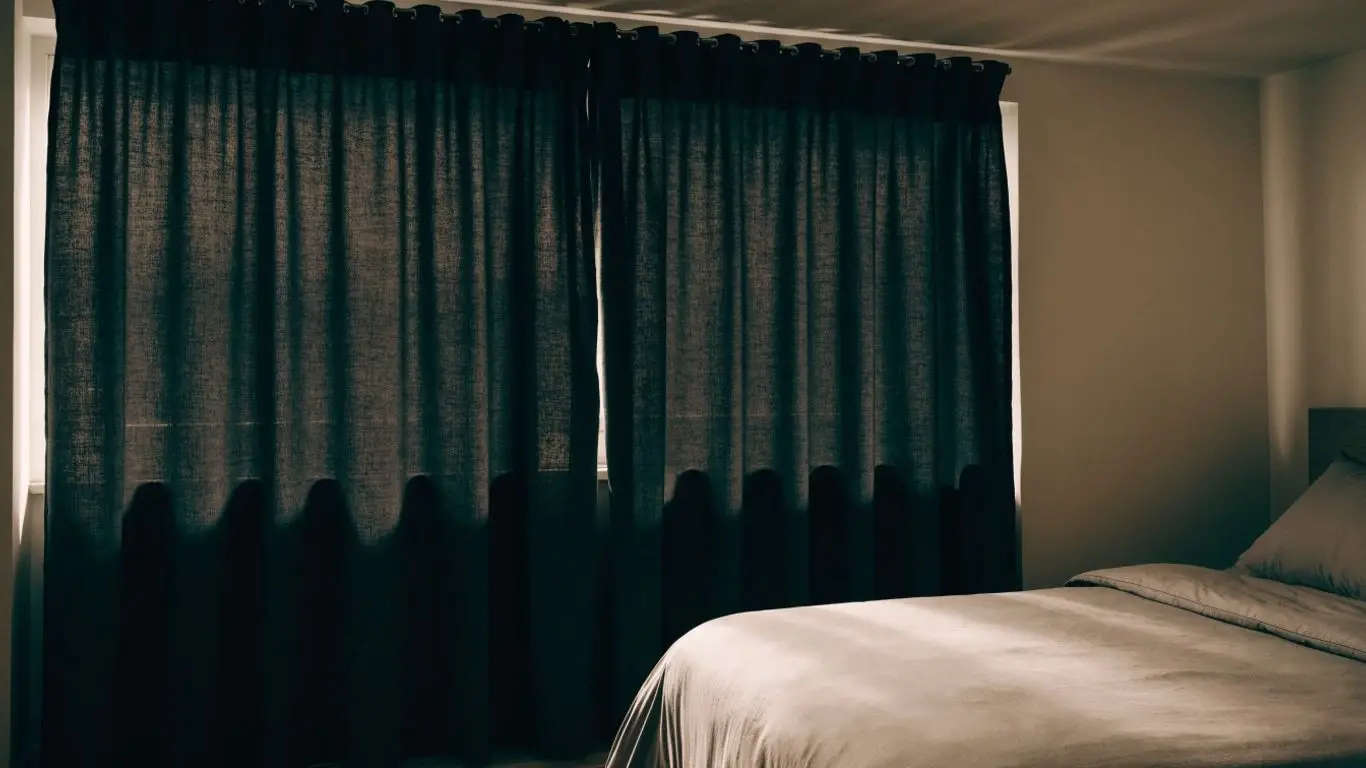
Inspect the curtain closed in the room conditions that matter. Light spread across the cloth points to transmission through the material or its construction. Small bright points or lines may require inspection of seams, stitching or damage. Light at the top, sides, centre meeting or hem follows a different path around the curtain.
Record the location before deciding what to change. Replacing the face fabric may leave a centre gap untouched, while adjusting a track cannot make a transmitting fabric opaque. Nighttime privacy also needs a check with interior lights on and the relevant outside viewing direction.
Agree How Darkness Will Be Reviewed
For a bedroom, consider early sun and exterior lighting as well as the preferred daytime appearance. For a living room or office, judge the actual glare and daylight level needed for the activities there. Avoid assigning one curtain category to every room purely by room name.
For repeated guestrooms, review a representative installation before releasing the full quantity. Connect any hotel room type and sample room coordination records to the selected fabric, track and drawing revision. Agree the review conditions and any measured acceptance criteria in advance. Photographs can record appearance, but different camera exposures do not provide a valid performance comparison.
Coordinate Tracks and Installation Conditions
Review the Top Sides and Centre Closure
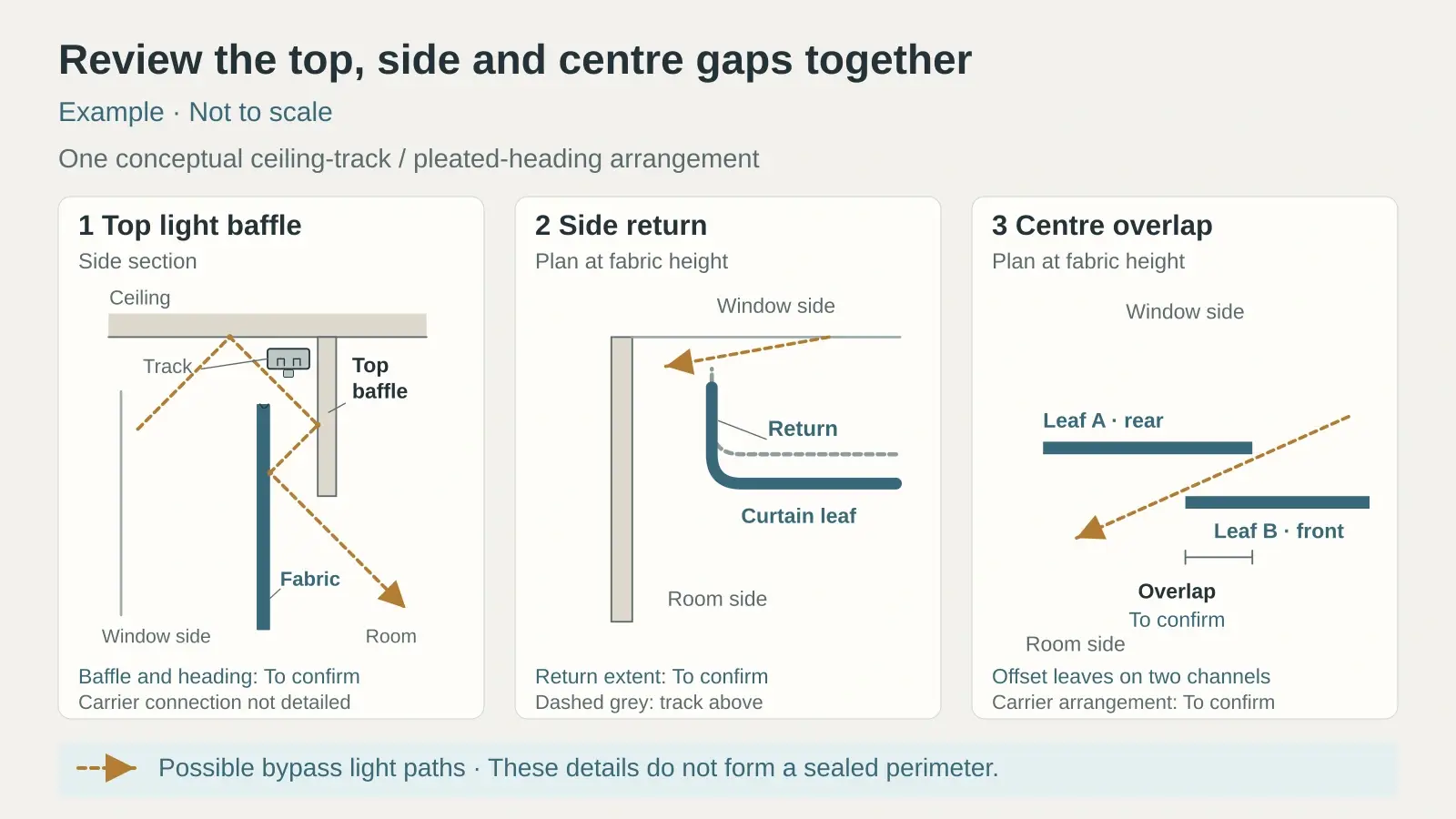
Draw the curtain’s relationship to the opening. Check the heading position, any pocket or pelmet above it, the side returns towards the wall, and the overlap where panels meet. Ceiling mounting alone does not remove every light path. A centre-draw pair also needs a compatible closure detail.
Lutron’s guestroom light-blockage guidance illustrates these interfaces and recommends reviewing a mock-up under actual site conditions. Its system dimensions are manufacturer examples, not universal clearances for every track or curtain heading.
Allow for Movement Support and Access
Confirm the track, carriers and brackets for the finished curtain weight and configuration. Check the fixing substrate and the installed clearance to window handles, opening sashes, radiators and furniture. Leave room for the fabric folds to stack when open, particularly where two tracks share a pocket.
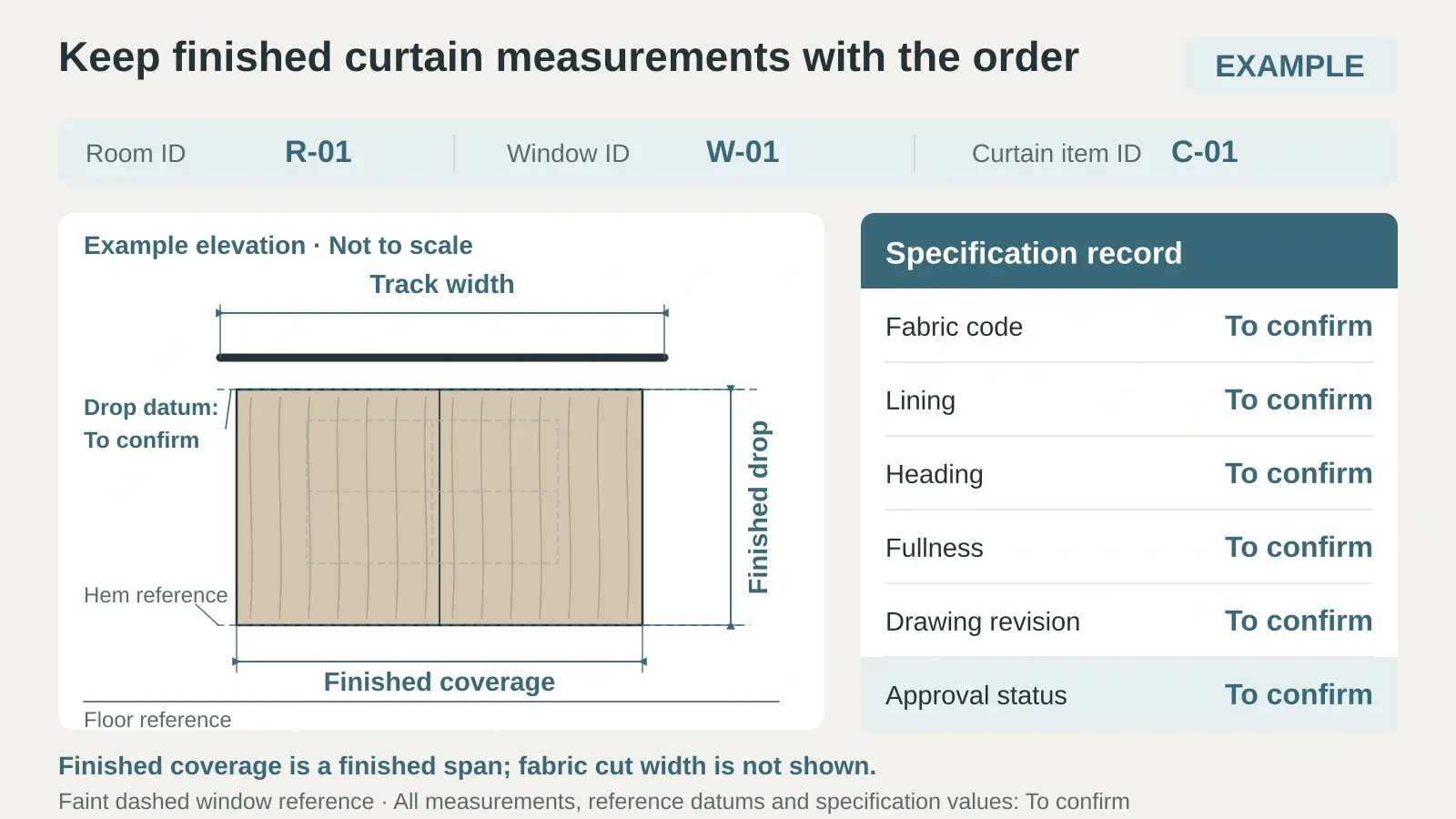
Link each curtain to the relevant window IDs and drawing references, while recording curtain dimensions separately from window frame dimensions. The installer and curtain maker should agree the measurement datum, finished drop, hem clearance and coverage. If motorised, include the motor position, power and control arrangements and maintenance access. Confirm operating safety and project requirements with the selected system supplier.
Specify the Finished Curtain Before Comparing Quotes
Keep Measurements and Supply Scope Connected
A track width, a closed curtain’s coverage and a panel’s flat fabric width are different measurements. Fullness describes the extra fabric used to form the heading and folds; the required amount depends on the selected heading, fabric and system. There is no single multiplier that suits every curtain.
Use room and item records in an FF&E schedule to keep the following information connected:
| Order record | What to confirm |
|---|---|
| Location and quantity | Room, curtain item and window IDs, drawing revision, number of sets and panels per set |
| Fabric and layers | Manufacturer, fabric and colour codes, face orientation, backing or coating, lining and any interlining |
| Finished dimensions | Coverage width, drop with its measurement datum, heading, fullness, seams and hems |
| Hardware and operation | Track or rod model, carriers, brackets, returns, closure detail, draw direction and motor or manual operation |
| Supply and installation | Who measures, supplies, fixes, connects power where needed, installs and adjusts; delivery and exclusions |
| Approval and aftercare | Sample references, accepted installation details, review status, care instructions and replacement requirements |
Compare quotations for the same finished scope. A fabric-only rate cannot be compared directly with a price including lined panels, tracks and installation. Keep quantities, pricing units, freight and taxes clear rather than assuming blackout always carries a fixed premium over dimout.
Approve Samples and Care Before Production
Use drawing and material sample coordination to connect the approved cloth and lining to the finished dimensions and track detail. Where a sample curtain is required, review it as an assembly before production release. Record unresolved items rather than treating a colour approval as permission to manufacture.
Obtain care instructions for the complete curtain, including the lining and any coating. Do not assume all blackouts require dry cleaning or that every product tolerates machine washing, steam or the same ironing method. Delius’s Jackson product information illustrates why washing-related dimensional change and coating-specific care need their own checks. Agree any required cleaning trial and acceptable dimensional change before making the full order.
Light control also does not establish fire, thermal or acoustic performance. Where those properties are specified, request evidence for the selected material and applicable assembly separately.
Frequently Asked Questions
Are Blackout Curtains Completely Lightproof
A verified blackout fabric can stop transmission through the material while the installed curtain still admits light around its edges. Review the fabric and the finished installation separately before accepting a complete-darkness claim.
Is Dimout the Same as Room Darkening
Retail descriptions can overlap, but the terms do not establish one universal transmission level. Some dimout fabrics allow very little light through. Check the exact product, colour and supporting data rather than relying on the category name.
Can I Add Blackout Lining to Dimout Curtains
It may be possible if the curtain construction and hardware can accommodate it. Confirm the lining coverage, attachment, weight, care and closure details with the maker. Added lining does not automatically resolve gaps around the installation.
Which Curtain Should I Choose for a Bedroom
Choose against the darkness you need at the window. A verified blackout assembly is a useful starting point when very low daylight is essential. Dimout may suit an acceptable level of remaining light. Review the actual sample and installation rather than choosing by colour or weight alone.
Planning a curtain package? Send your curtain schedule and window references, with room quantities, verified measurements, fabric direction, light-control requirements, track details and the proposed installation scope.