A spare parts handover checklist connects each replacement item to the installed product, its agreed quantity, its package and its maintenance records. The receiving team should be able to identify the correct part, find it in storage and understand any outstanding checks before it is issued for use.
For a building project, this may include cabinet hardware, door and window components, lighting drivers and sanitary fittings. Agree the handover scope, count date and responsible people first. Use the checklist below to review the stock and records together, while keeping physical receipt and technical acceptance clearly identified.

Spare Parts Handover Checklist at a Glance
Record the project, handover date, register revision, outgoing owner, receiving owner and count cut-off time. Then check each of the following against the same register:
- Confirm the installed item reference, manufacturer replacement code and relevant revision.
- Agree the required quantity, unit and contents of each kit or set.
- Reconcile receipts, issues and physical stock at the agreed cut-off time.
- Match outer packages and inner labels to the part record and storage location.
- Record packaging condition, damage and any product-specific storage or expiry requirements.
- Transfer the applicable operation and maintenance documents, supplier contacts and ordering references.
- Assign shortages, uncertain identities and other open items to an owner and target date.
- Record what was received and accepted, including any exclusions or remaining conditions.
Use a separate line when the part code, configuration, unit or review status differs. Keep replacement stock, consumables and special tools distinguishable so the receiving team knows what each quantity represents.
Match Replacement Part Codes to the Installed Item
Record the Exact Part Number and Installed Reference
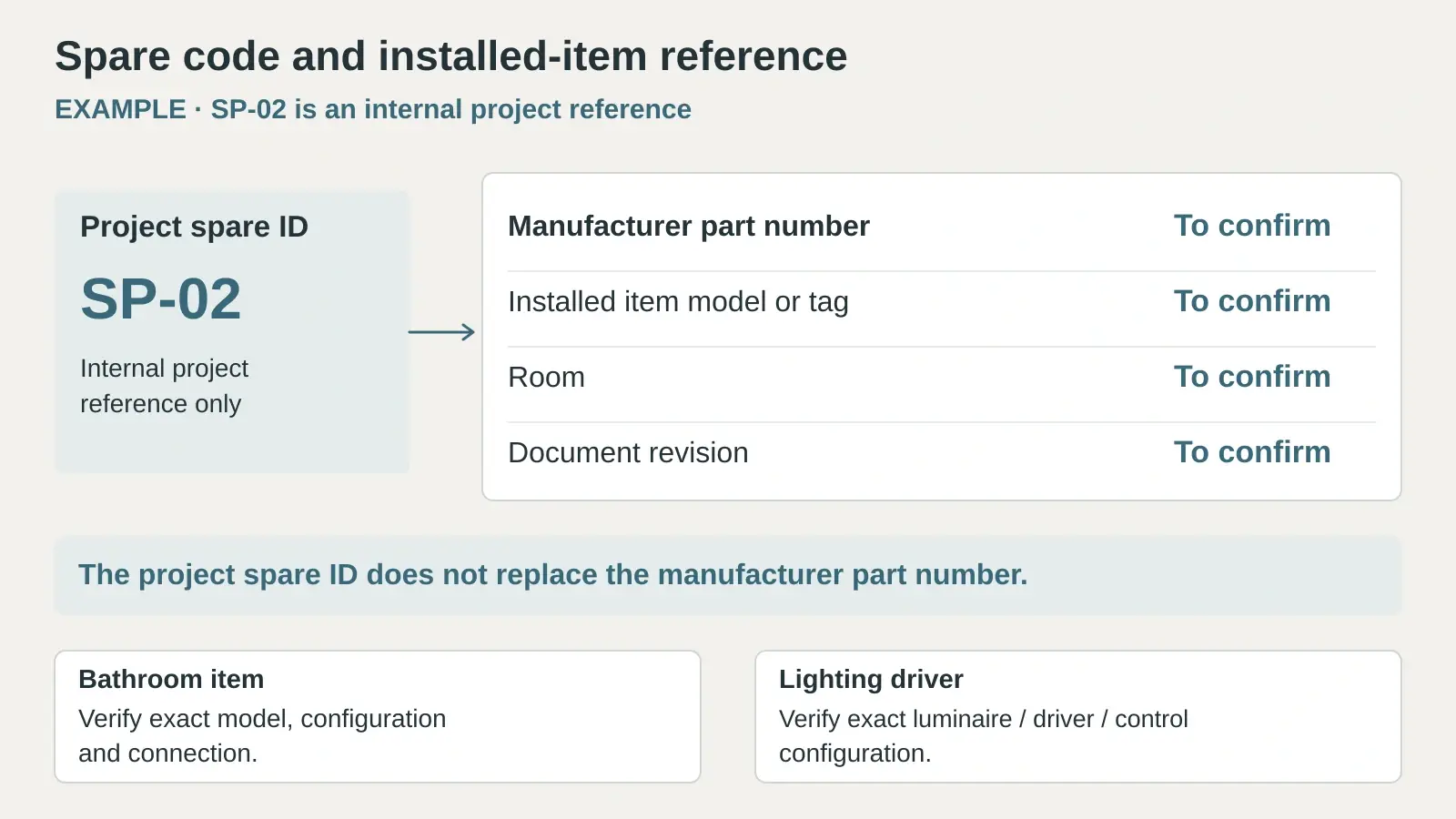
Capture both the project’s internal spare reference and the manufacturer’s replacement part number. Add the description, installed model or item tag, relevant drawing or schedule revision, and the room or location served. Connect these fields to the room and item records in an FF&E schedule where applicable. A project code such as SP-01 alone will not normally identify what to reorder.
Check the full code, including suffixes that distinguish finish, handedness, size, connector or other configuration. Keep a readable label photograph and the source used to identify the part. For sanitary products, Geberit Pro illustrates how product identification can lead to an article number, spare parts information and installation manuals. Apply that principle to the selected manufacturer’s own records rather than matching by appearance.
Verify Substitutions Before Release for Use
Record the original specified code, proposed replacement, reason for substitution and written compatibility decision. For cabinet hardware, check the relevant hinge or runner arrangement and fixings. And for sanitary components, retain the parent fixture model and applicable fixture models and accessory references.
For a lighting driver, retain the full model, output type, current or voltage configuration, control interface and relevant luminaire reference. The Tridonic driver data sheet shows why these are distinct product fields; matching wattage alone does not establish compatibility. Link the replacement to the driver and dimming records in a lighting schedule and obtain the appropriate technical review before installation.
Count Quantities and Reconcile Differences
Agree Units and Set the Counting Time
Agree quantities from the purchase scope, approved spare list or maintenance plan. There is no single spare percentage suitable for every component. Record whether the quantity is each, pair, kit, set, metre or another agreed unit. Define kit contents, including associated plates, connectors or fixings, so a sealed carton is not mistaken for one complete assembly.
Count in the assigned locations and record who counted and when. Reconcile opening stock, receipts, documented issues and returns to the physical balance. Spare parts used during commissioning or repairs are no longer available for final handover unless replenished. If movements continue during counting, keep a transaction log so an item is not counted twice or omitted.
Separate Quantity Differences from Review Status
Keep the agreed, recorded and physically counted quantities visible. Explain each difference rather than replacing the expected figure with the count. A shortage may require a recount or supplier follow-up; excess stock may be an unrecorded receipt or an incorrectly identified item.
Record quantities held for identification, condition review or compatibility confirmation separately from quantities cleared for issue. Do not subtract the same held item twice: it remains physically present, with its use restricted. Receiving a package, matching its code and approving its installation are separate checks. Avoid an unexplained status such as complete when one of those decisions remains open.
Check Packaging Labels and Storage Locations
Link Outer Cartons and Inner Packs
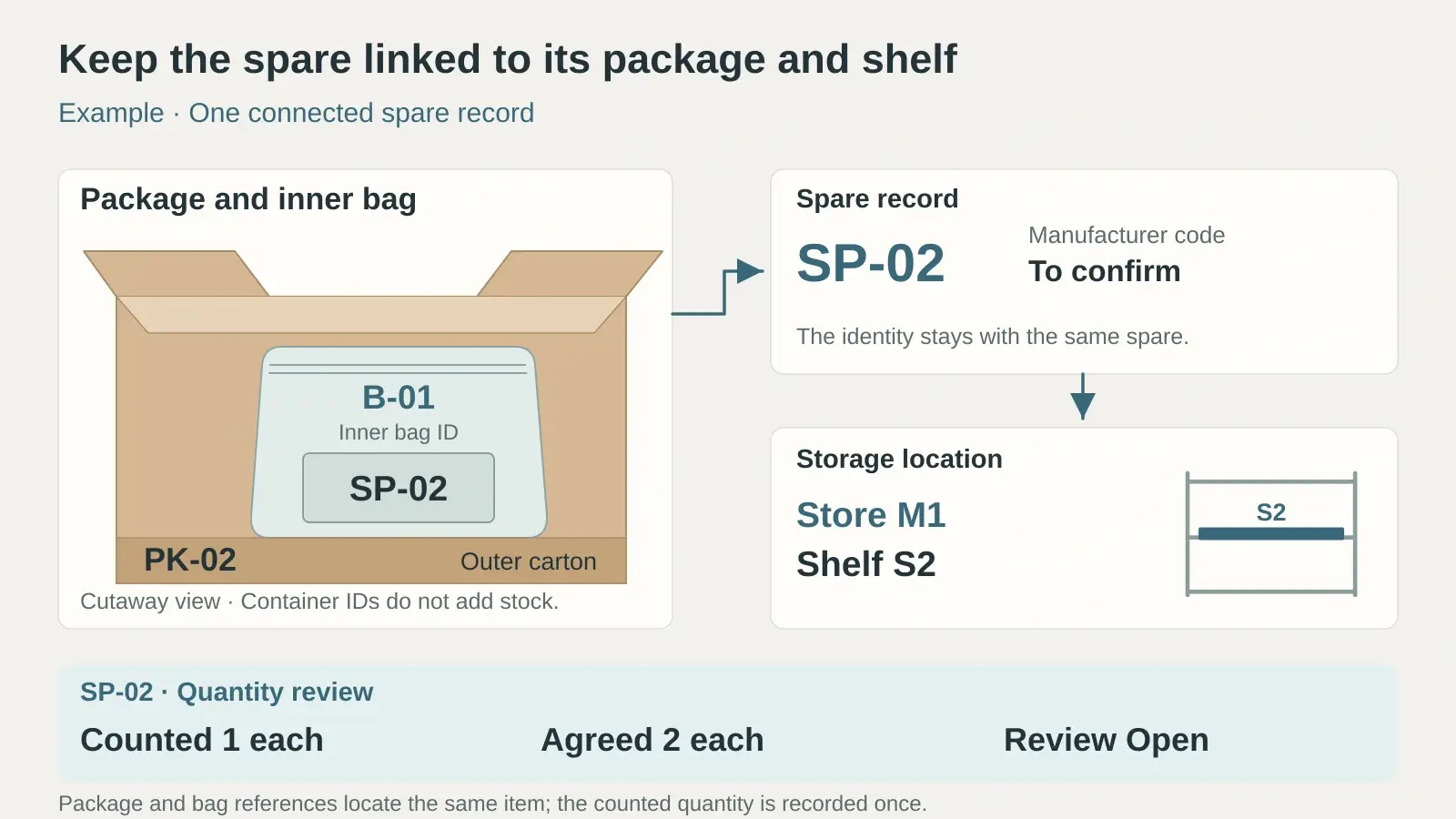
Keep original manufacturer labels and protective packaging where suitable, and add a project label that cross-references the spare record. Use outer package IDs and inner bag or kit IDs so the part remains identifiable when the carton is opened. The package IDs and hardware bag records used for cabinet deliveries provide a useful structure for this connection.
Record the part reference, quantity and unit, package ID, destination store and shelf or bin. Keep mixed items separated within a carton and list its contents. An outer carton containing several inner packs needs one reconciled contents record; counting the inner items and the carton as additional stock would overstate the quantity.
Check Condition and Storage Requirements
Inspect for wet or torn packaging, impact damage, corrosion, contamination and unreadable labels. Record visible observations against the specific package, with photographs where useful. If opening a sealed or sensitive package would compromise protection, agree how its contents will be verified and record any limitation on the count.
Preserve the manufacturer’s stated storage and handling conditions, including expiry or preservation dates where applicable. Moisture protection, electrostatic precautions and storage temperature depend on the actual part and packaging. Separate questionable stock from material cleared for use, label the reason for the hold and name the person who can resolve it. Do not dispose of or relabel uncertain stock merely to close the checklist.
Transfer Maintenance Records and Responsibilities
Provide a Usable Document Index
Link the spare record to applicable operation and maintenance instructions, parts diagrams, approved substitutions, inspection notes, supplier contact details and purchase references. Include warranty terms and claim instructions where available, without assuming every spare has the same coverage. Record missing documents as open items with a responsible person.
Use an index that gives the document title, revision or date, related part or installed item, and file location. The National Academies asset information handover guide includes sample airport project language connecting spare lists and maintenance information to the owner’s asset records. Its example supports that connection; the project’s own agreed handover requirements determine the actual deliverables.

Test Retrieval and Record Acceptance
Ask the receiving maintenance or stores team to locate a representative spare from the register and retrieve its relevant instructions using their own authorised access. Confirm the storage owner and the process for recording future issues or reorders. Keep agreed lead-time and reorder information separate from estimates that still need supplier confirmation.
Before signing, identify the final register revision, stock locations, accepted quantities and remaining exceptions. For each open item, record the action, owner, target date and closure evidence. Procurement records from drawing sample and delivery coordination can support the review, while the project’s designated owners retain their assigned acceptance responsibilities. A conditional receipt should state its conditions rather than imply that all technical checks are complete.
Filled Spare Parts Handover Record Example
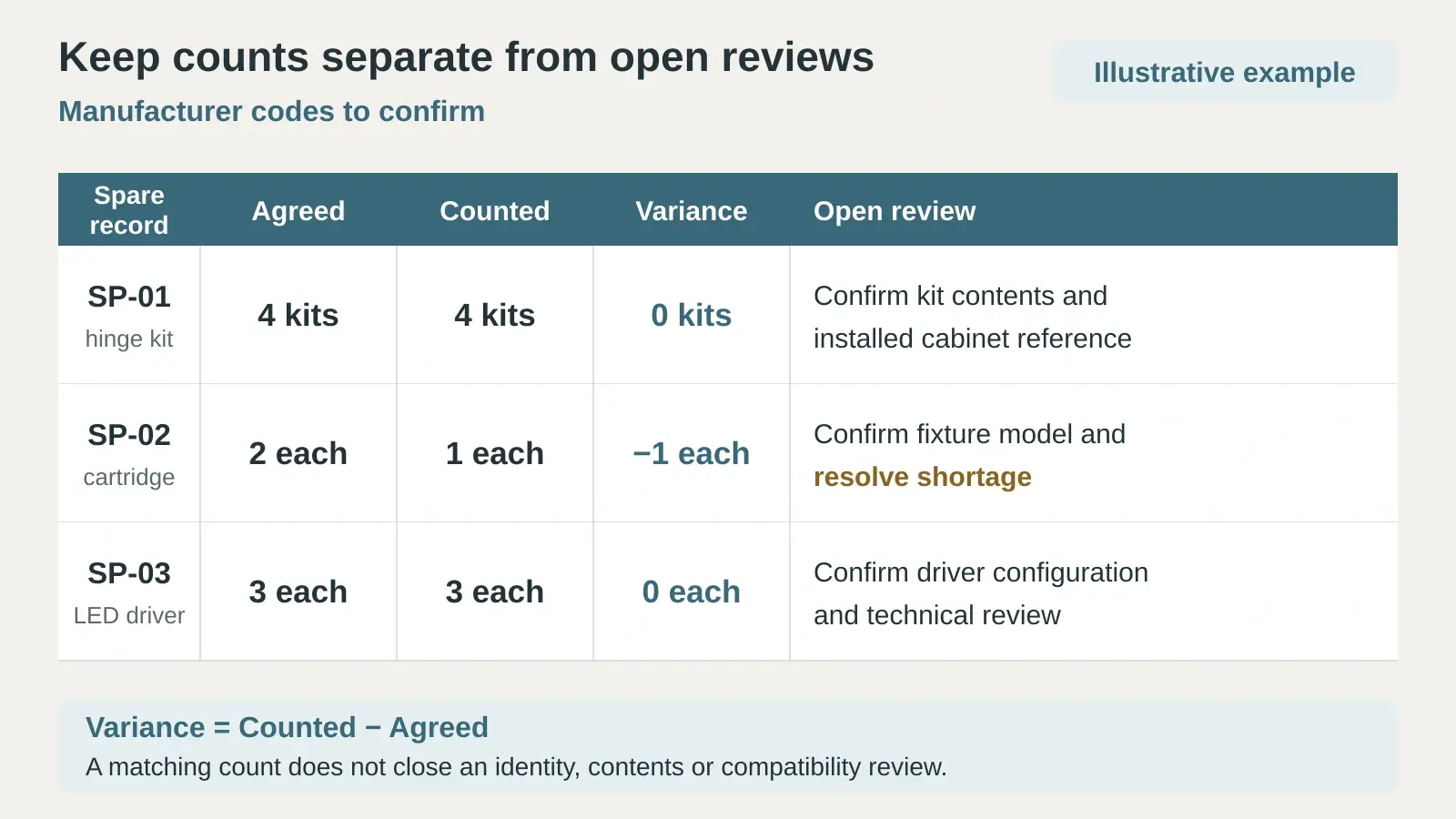
The following is an illustrative count review, not an approved parts specification. SP codes are internal record IDs; manufacturer part numbers and installed-item references still need to be completed and checked. Quantity variance below means counted quantity minus agreed quantity, using the same unit on each line.
| Spare record | Agreed | Counted | Variance | Open review |
|---|---|---|---|---|
| SP-01 hinge kit | 4 kits | 4 kits | 0 kits | Confirm kit contents and installed cabinet reference |
| SP-02 cartridge | 2 each | 1 each | −1 each | Confirm fixture model and resolve shortage |
| SP-03 LED driver | 3 each | 3 each | 0 each | Confirm driver configuration and technical review |
For SP-02, the package record might read package PK-02, inner bag B-01, store M1, shelf S2. These are example identifiers only. Retain the counted item under its recorded review status and assign the missing item for follow-up. A zero count variance on SP-01 or SP-03 does not close the outstanding technical or contents check.
Complete each line with its actual manufacturer code, condition, held quantity, document references and acceptance status. Add the count date and reviewer, then record the names and roles of the outgoing and receiving owners, register revision, conditions and sign-off date. Leave approval and closure fields open until the responsible people have made those decisions.
Frequently Asked Questions
What Should a Spare Parts Handover Checklist Include
Include replacement codes, installed-item references, agreed and counted quantities, units, package and storage IDs, condition notes, maintenance documents and acceptance records. Give each unresolved item an owner and target date so the receiving team can follow it through.
How Many Spare Parts Should Be Handed Over
Use the agreed procurement scope and maintenance requirements for each item. Consider the installed population, service needs, lead time and storage limits. Record the approved quantity basis instead of applying one percentage across unrelated components.
Can a Box Count Replace a Part Count
Only when the contents and unit basis have been defined and verified to the agreed level. Record the quantity per inner pack and the number of packs. Note unopened or unverifiable contents so the record does not imply a full physical check.
Does a Signed Delivery Note Confirm Compatibility
A delivery signature can record receipt without approving every item’s identity, condition or compatibility. State what each signature covers and retain any technical approval or exception record separately, according to the project’s agreed process.
Who Should Receive the Maintenance Information
The named owner responsible for maintenance or stores should receive the applicable records and usable access. Include any project technical reviewer needed to resolve substitutions or uncertain parts, and confirm who maintains the register after handover.
Send your spare parts list and handover requirements with the installed product references, agreed quantities, packing details and open questions for a coordinated review of the supply scope.