A curtain schedule template in Excel connects each window to its curtain dimensions, fabric, lining, track and review records. Use it to prepare a room-by-room enquiry, compare the same scope across suppliers and trace changes before an order is released.
The editable workbook includes blank registers and a separate filled example. It suits owners, designers and contractors coordinating curtains for villas, apartments or hotel rooms. Start with the window references and information available, then keep outstanding measurements and selections visible throughout your curtain and soft furnishing coordination.

Download the Curtain Schedule Template in Excel
Download the Curtain Schedule Template Excel workbook
The workbook contains four sheets:
- Schedule records room, window and curtain IDs, drawing references, dimensions, quantities and measurement status.
- Specifications records each curtain's fabric, lining, heading, track and supporting review references.
- Review Log records individual decisions, revisions, open actions and order-release information.
- Filled Example shows three illustrative curtain records, including two treatments at one window and a second window awaiting measurements.
Enter project data in the blank registers. Keep the example separate so its dimensions and sample codes cannot be mistaken for your approved selections. Dimensions use millimetres in this workbook; retain the stated unit when copying values from drawings or supplier documents.
Curtain Schedule Template Fields
Room Window and Curtain IDs
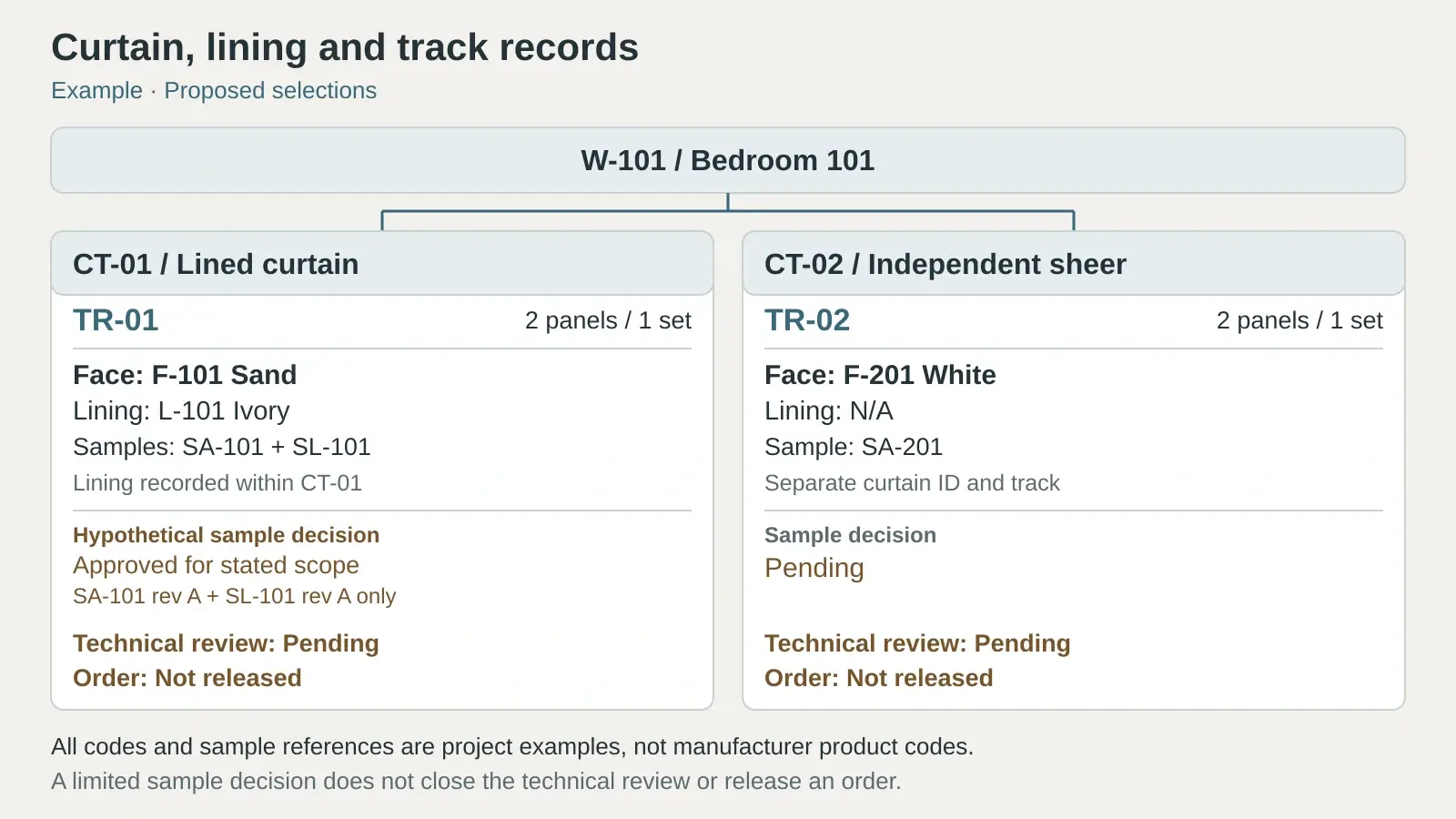
Use the window ID already shown on the plan or elevation. Give each curtain treatment its own curtain ID, and give the associated track a track reference. For example, a lined curtain and an independently operated sheer at W-101 need separate curtain records even though they serve the same opening.
Link the window IDs and drawing references to the current plan, elevation and relevant detail revision. Add the room, floor and treatment description so the supplier can locate the item. Connect quantities to the room allocations in an FF&E schedule when curtains form part of a wider room package. Count a centre-opening pair as two panels and one set only when that is the agreed quantity basis.
Dimensions and Measurement References
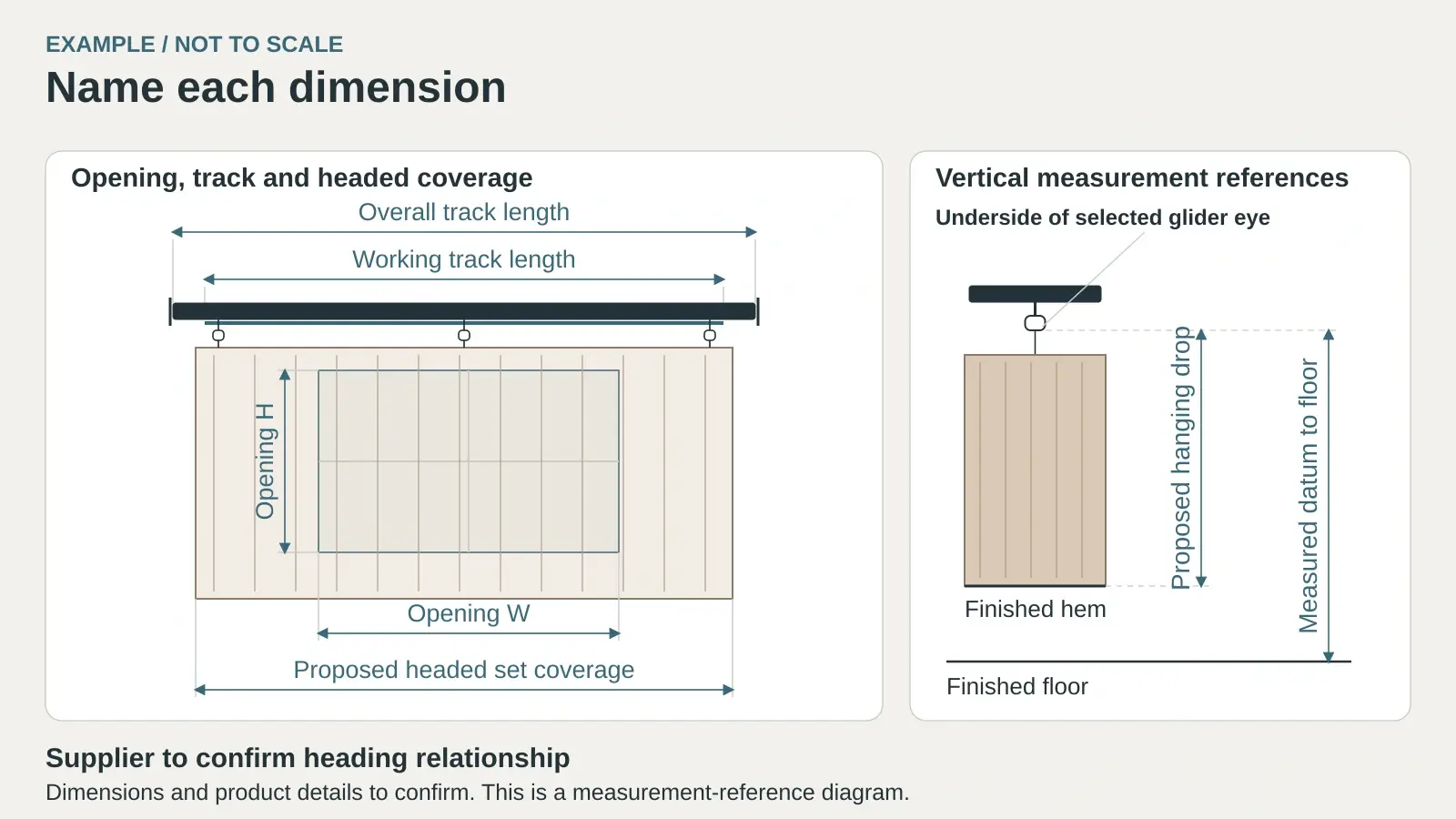
Keep opening dimensions, track lengths and finished curtain dimensions in separate fields. A window frame width does not define the curtain's required coverage, stacking space or finished drop.
| Record | What the value describes | What to confirm |
|---|---|---|
| Opening width and height | The referenced opening on the drawing or site | Measurement source, unit and finished site condition |
| Working track length | The useful track length under the selected system's definition | Carrier travel, returns, bends and any system-specific exclusions |
| Overall track length | The full assembly length under the supplier's definition | End components, finials where applicable and space available |
| Finished curtain width | The specified panel or set width | Single panel or whole set, and flat width or headed coverage |
| Finished hanging drop | The agreed upper datum to the finished hem | Heading, hook or glider relationship and bottom condition |
Record who measured, when, and from which datum. Use a separate site measurement or document reference to retain raw readings. A proposed finished hanging drop is an order dimension awaiting confirmation; it should not silently replace the measured distance to the finished floor.
Fabric Lining and Track Specifications
Identify the face fabric by supplier, product code, colour and sample reference. Record a separate lining code and sample where used. State whether the light-control layer is a separate lining, a backing on the face fabric, or another construction. For an unlined sheer, enter an explicit not-applicable selection rather than leaving the lining requirement ambiguous.
Add the heading style, associated making instruction, track model, mounting method, opening direction and control method. Record supplier codes precisely; a project reference such as F-101 or TR-01 does not identify a manufacturer's orderable product by itself.
Filled Curtain Schedule Example
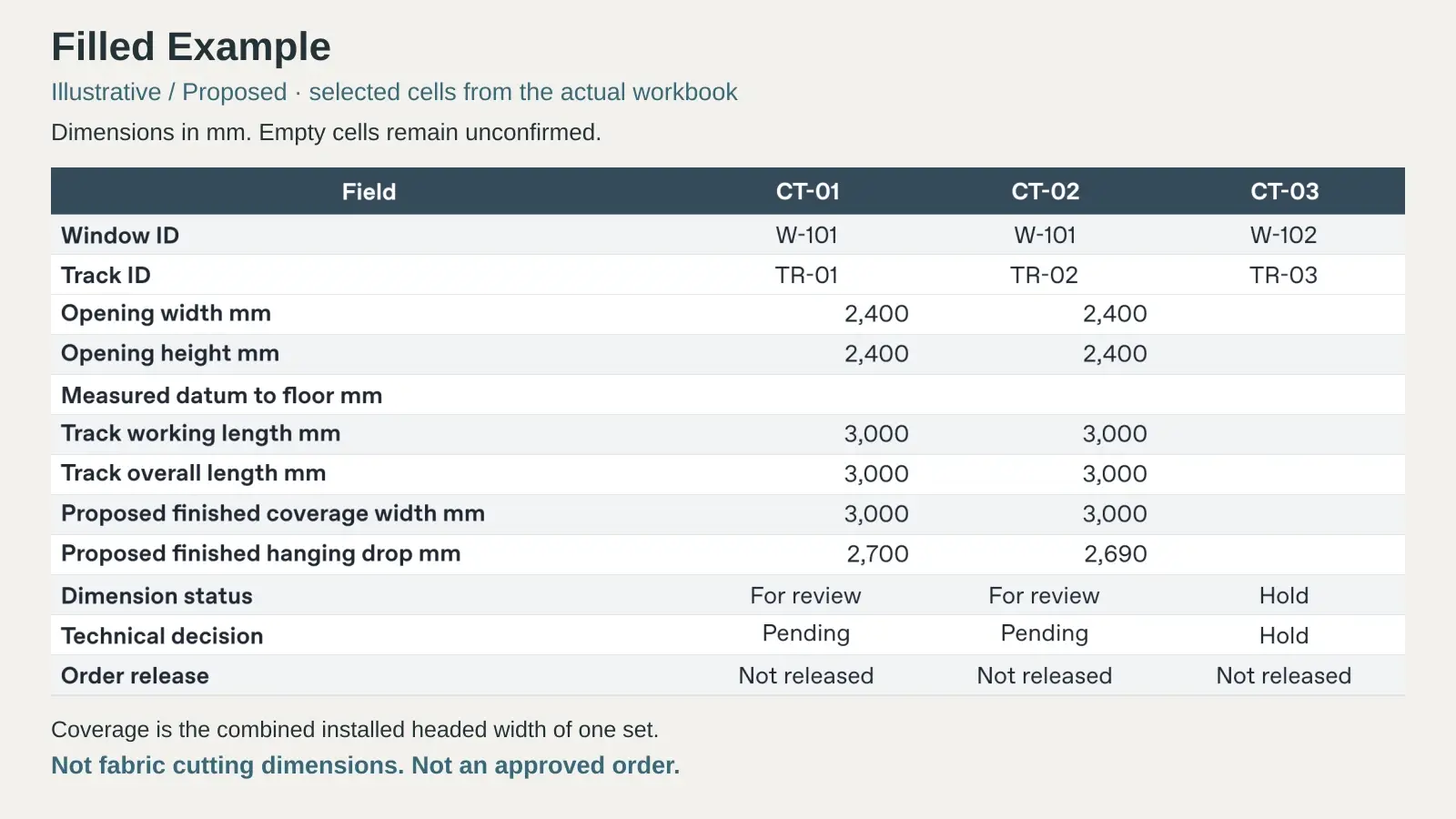
The following records illustrate how the fields connect. All codes and dimensions are project examples. They are proposed information, not manufacturer product codes, approved sizes or a cutting instruction.
| Curtain and window | Treatment and track | Proposed dimensions in mm | Review still required |
|---|---|---|---|
| CT-01 at W-101, Bedroom 101 | Face curtain F-101 Sand with lining L-101 Ivory; TR-01 | Opening 2400 × 2400; working and overall track 3000; headed set coverage 3000; hanging drop 2700 | Confirm hanging datum, track configuration and technical review |
| CT-02 at W-101, Bedroom 101 | Sheer F-201 White; no lining; separate TR-02 | Same opening; working and overall track 3000; headed set coverage 3000; hanging drop 2690 | Confirm sheer sample, independent track and layer clearance |
| CT-03 at W-102, Bedroom 102 | Face curtain F-102 Stone with lining L-102 Ivory; TR-03 | Site, track and finished dimensions remain blank | Complete site measurements and wall-fixing review |
Example for One Window with Two Treatments
CT-01 and CT-02 each have two panels and one set. Their shared W-101 reference connects them to one opening; their separate TR-01 and TR-02 references identify two tracks. A lining attached to CT-01 is recorded within that treatment, rather than counted as another independently operated curtain set. The hypothetical EX-SAMPLE-01 record approves CT-01's stated sample scope only; its technical review remains pending and its order status remains Not released.
For this straight-track example without finials, the proposed working and overall lengths are both 3000 mm. That equality is an example entry, not a rule for every track. The finished widths describe installed headed coverage across both panels; they are not flat fabric widths. The example drop datum is the underside of the selected glider eye to the finished hem, subject to the supplier confirming the heading and hook relationship. The 2700 mm and 2690 mm values are proposed hanging drops, not measured floor distances or fabric cutting lengths.
Example with Measurements and Fixings Still Open
CT-03 retains its room, window and proposed fabric references while dimensions remain empty. The next action is to measure the relevant site condition and confirm the wall support and fixing arrangement. Entering a fabric code or obtaining a sample decision does not resolve those outstanding tasks. The example records remain unreleased for order.
How to Fill In the Curtain Schedule
Measure from a Defined Datum
Identify the proposed track or pole position before taking final curtain measurements. Record the opening and surrounding conditions, including ceiling recesses, projections, handles, radiators and the finished floor level where relevant. For each drop, name the upper reference point and intended bottom condition so the workroom and installer use the same meaning.
Where flooring, ceilings or the track position are unfinished, label the measurement status and arrange a final check. Do not apply an automatic floor deduction, extra width or fullness factor to every opening. Preserve the source readings and record any agreed adjustment in the relevant drawing or making instruction.
Confirm Fabric Lining and Heading Together
Review the face fabric, lining and heading as one curtain construction. Retain sample codes, colour decisions, care information and the selected supplier's making requirements. Use the blackout and dimout fabric and lining choices guide when defining light-control requirements; also record the intended treatment of top, side and centre gaps.
Fullness depends on the selected heading and system. The Silent Gliss Wave workroom guide, for example, connects glider and hook spacing to the curtain's fullness and stack. It distinguishes finished fabric fullness from additional material needed for joins, hems and workroom allowances. Ask the workroom to confirm fabric requirements using the actual fabric width, pattern repeat, orientation and making method.
Review Tracks and Installation Conditions
Confirm the actual track model, mount, draw direction and relationship between layers. Check stack space, curtain movement and clearance from adjacent finishes. For motorised systems, retain the power, control and access requirements with the relevant technical submission.
Track selection also depends on the curtain load and installation support. The Lutron drapery track specification illustrates how system configuration, clearances and fixing into suitable support are related. Use the chosen manufacturer's current requirements for the actual model rather than copying another system's bracket spacing or capacity.
Record the desired light-control outcome and review the complete installation. Lutron's light-blockage guidance explains the importance of coordination between the track installer and curtain workroom, including gaps and stack-back interference. A fabric or lining label alone does not establish the completed room's light-blocking performance.
Keep Review Records and Order Release Separate
Log Each Decision Against a Revision
Keep measurement review, sample review, technical review and order release identifiable. In the Review Log, record the curtain ID, review type, document or sample revision, decision, reviewer and date. Add the action, owner and target date for unresolved items, followed by closure evidence when available.
An approved colour sample records that particular selection decision. It does not approve site dimensions, track fixings or the final order. A change to fabric, lining, heading or track can affect other fields, so identify which earlier reviews need to be repeated. Use drawing and material sample coordination to keep the current submissions connected to the same curtain IDs.
Resolve Changes Before Order Release
Before release, compare the current schedule, specifications, measured information and supplier submission. Confirm quantities, codes, dimensions, track scope and unresolved actions. Record the authorised release decision and its applicable revision instead of treating a completed row or a quotation as approval to manufacture.
After a change, retain the previous issue and record the affected curtain IDs in the new revision. Distribute the current issue to the people quoting, making and installing the curtains so each team is working from the same information.

Use Excel Checks Without Replacing Technical Review
Use the workbook's entry checks to find missing core fields, duplicate curtain IDs and specification links needing attention. Keep one curtain ID consistent across the registers. Review the whole row after sorting or filtering, and add new records within the prepared entry area or extend the table, formulas and validation together.
The checks help locate data gaps. They do not verify a site measurement or make an approval decision. The workbook does not calculate fabric metres from opening width or assign automatic order approval. The workroom confirms the making quantities, and the designated project reviewer records the release decision.
Frequently Asked Questions
What Should a Curtain Schedule Include
Include room and window references, curtain and track IDs, clearly defined dimensions, panel and set quantities, fabric and lining codes, heading and track details, sample references and review records. Retain the drawing revision and the owner of each open action.
Is a Curtain Schedule the Same as a Window Schedule
A window schedule records the window unit or opening. A curtain schedule records the treatment serving it. Use the same window ID to connect them, while keeping curtain dimensions separate from window frame dimensions.
Should Sheers and Lined Curtains Have Separate Rows
Use separate curtain records when they are independently operated or have different specifications. An attached lining can remain part of the lined curtain's record. Identify the actual track arrangement so sharing a window ID does not cause double-counting.
Can This Excel Template Calculate Curtain Fabric Metres
It records finished dimensions and making references, but does not apply a universal fabric formula. Fabric width, repeat, joins, hems, heading and pattern matching affect the workroom's quantity. Obtain the calculation and confirmation for the selected construction.
Does a Complete Row Mean the Curtain Can Be Ordered
A complete row means the selected fields have entries. Ordering also requires the applicable measurement, sample and technical decisions and an authorised release against the current revision. Record those decisions explicitly and keep outstanding actions visible.
Send your curtain schedule and window references with the drawings, sample choices, proposed dimensions and open questions for a coordinated review of the supply scope.