By George House/20,May,2026
Interior door dimensions can refer to the door slab, the assembled frame, the structural rough opening or the clear passage after the door and hardware are installed. These measurements are not interchangeable. Ordering a nominal door width without defining the measurement point can cause fitting, accessibility and finish conflicts.
Coordinate each opening within the complete project door and window package. The door schedule should connect room use, leaf size, frame, wall thickness, handing, hardware, finish and installation requirements.
Five dimensions to distinguish
| Term | What it measures | Use |
|---|---|---|
| Door leaf or slab | The movable panel itself | Product size and hardware preparation |
| Frame outside size | The maximum assembled frame dimensions | Fit within the prepared wall opening |
| Rough opening | The structural opening before the door set is installed | Framing and installation allowance |
| Clear opening | The usable passage with the leaf open | Access, circulation and code review |
| Jamb depth | The frame dimension through the wall thickness | Alignment with wall finish and trim |
A 32-inch nominal leaf does not provide a 32-inch clear passage because the open leaf, stops, hinges and hardware reduce the usable width. Likewise, a rough opening is not automatically two inches wider and taller than every slab. Allowances vary by frame system, installation method, floor condition and manufacturer.

Common interior door size references
In many North American residential projects, an 80-inch nominal leaf height is common, and leaf widths are often selected in regular increments. Bedrooms and primary circulation routes may use wider leaves than small storage openings. These are market conventions, not universal rules. Country, building type, occupancy, accessibility brief and supplier system can change the available and required sizes.
Use the ranges in the standard interior door size guide for early planning. Before procurement, confirm the exact leaf and frame data for the selected product and the requirements of the project jurisdiction.
Room use and door selection
Bedrooms and living areas
Select a width that supports normal circulation and the planned movement of furniture. Check the route from the building entrance to the room, not only the bedroom opening. A wider leaf also needs more wall and swing space, so test the door against wardrobes, switches and furniture.
Bathrooms and compact rooms
A narrow opening may save wall space but can reduce access and make fixture conflicts worse. Confirm whether the door swings inward, outward where permitted, slides or uses another system. The choice should consider privacy, emergency access, ventilation strategy and the applicable code rather than a single default width.
Closets and storage
Closet doors may be hinged, paired, sliding or folding. The opening width must be coordinated with drawers, shelves and hanging zones inside. A large nominal opening can still provide limited access if sliding leaves overlap.
Accessible routes
Accessibility requirements are based on clear opening and maneuvering space, not nominal leaf width alone. The Americans with Disabilities Act applies to defined facilities and scopes; it should not be presented as a blanket rule for every private dwelling. Review the project’s applicable accessibility standard, occupancy and local code with the responsible design professional.
How to measure an existing opening
- Identify whether the work is a replacement leaf, a prehung door set or a new framed opening.
- Measure width at the top, middle and bottom and record all readings.
- Measure height at both jambs from the relevant finished floor level.
- Check diagonals and use a level to identify out-of-square or out-of-plumb conditions.
- Measure wall thickness at several points, including the planned finish build-up.
- Record stops, rebates, hinges, strike, architrave or casing and threshold details.
- Confirm handing and swing from an agreed reference side.
- Photograph and dimension nearby switches, furniture, services and floor transitions.
For a broader site sequence, follow the door measurement guide and issue the survey together with the opening reference used on the plan and schedule.
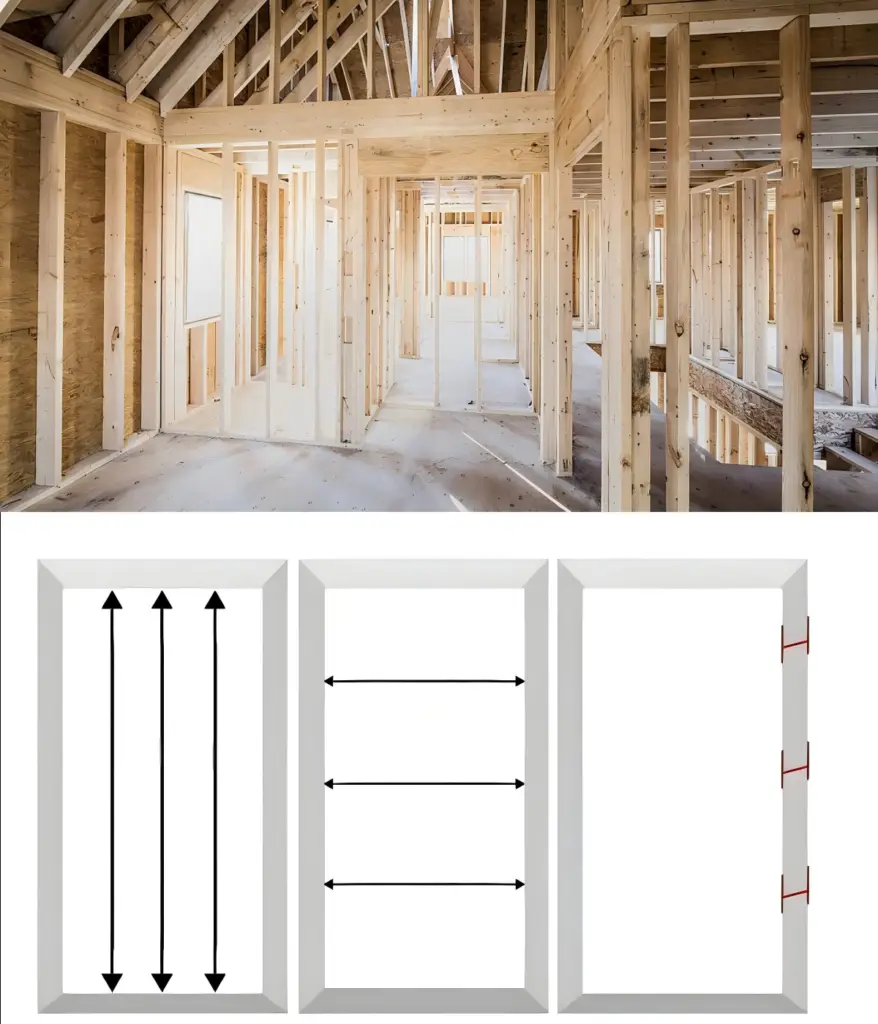
Rough opening and frame coordination
The frame supplier should state the required rough opening or installation clearance for the selected system. The allowance must accommodate the assembled frame, shimming, fixing and tolerances without creating unsupported gaps. Fire-rated, acoustic, concealed-frame, pocket and other specialist doors may have different preparation requirements.
Frame width through the wall must align with plaster, tile, paneling or other finish. Review door frame width and rough opening guidance and confirm whether casing, extensions or shadow gaps are part of the frame package.
Flooring, undercut and threshold
Set door heights from a consistent project datum and coordinate finished floor levels on both sides. Tile, timber, carpet and underlay can change the available undercut and the frame position. The required gap depends on ventilation, smoke or acoustic performance, threshold detail and manufacturer instructions. Do not trim a performance-rated leaf outside its permitted limits.
Handing and swing clearance
Record handing with a diagram or the supplier’s agreed convention, because naming conventions can differ. Draw the open leaf against walls, cabinets, sanitary fixtures and circulation routes. Check lever projection and whether door stops, closers or hold-open devices are required. Use the door swing direction guide to coordinate the schedule and plan.
Interior door schedule checklist
- Opening number, level and room-to-room location.
- Door type, quantity, leaf width, height and thickness.
- Frame type, outside size, jamb depth and finish.
- Required rough opening and permitted installation tolerance.
- Required clear opening and applicable accessibility basis.
- Handing, swing, pair or sliding configuration.
- Hinges, lockset, handles, stops, closer and seals.
- Floor finish, undercut, threshold and transition detail.
- Fire, acoustic, moisture or other performance requirement with supporting documentation.
- Survey, shop drawing, sample, installation and inspection status.
Final planning advice
Start with room use and required clear passage, then select the leaf and frame system. The supplier’s dimensioned details should set the rough opening, wall interface and hardware preparation. A coordinated schedule prevents nominal slab dimensions from being mistaken for frame or clear-opening sizes.