By George House/30,Dec,2025
Stair handrail height is measured to the top of the gripping surface, not to the top of a nearby guard or decorative post. In many U.S. accessibility and model-code applications, 34–38 inches (865–965 mm) above the stair nosings is the familiar range, but the adopted local code, occupancy and existing-building conditions control the project.
Use this guide to separate handrail height from guard height, measure a sloped stair correctly and prepare a coordinated railing request. It is a planning guide, not a substitute for approval by the authority having jurisdiction or the project design professional.

Stair Handrail Height at a Glance
| Item | Planning Reference | What Must Be Verified |
|---|---|---|
| Handrail gripping surface | 34–38 in (865–965 mm) is a common U.S. code range | Adopted code, occupancy, stair type and measurement point |
| Measurement | Vertical from the line connecting tread nosings to the top of the grip | Finished nosing profile and consistent height along the flight |
| Lower child handrail | May be added where the applicable standard permits or recommends it | Separation, clear width and whether the upper rail remains compliant |
| Guard | Not the same element or measurement as a handrail | Local guard height, opening limits, loads and climbability rules |
| Landing and ramp rails | May use related but not identical provisions | Extensions, continuity, transitions and project-specific requirements |
The U.S. Access Board states that the top of a handrail gripping surface is 34 inches minimum and 38 inches maximum above stair nosings and must remain at a consistent height. Its stairway guidance also covers continuity and handrails on both sides in facilities within its scope. Local building codes can add or modify requirements, so treat the range as a verification point rather than a universal instruction.
Handrail Height Is Not Guard Height
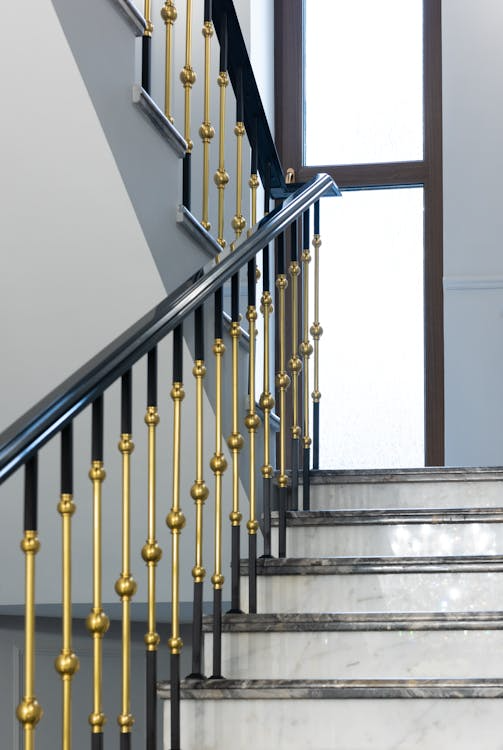
A handrail is shaped and positioned for grasping while a person uses the stair. A guard reduces the risk of falling from an open edge. One railing assembly can perform both functions, but each function still has its own height, geometry and performance criteria. Measuring only the top of a balustrade can therefore produce the wrong handrail result.
Ask the drawing to label the handrail gripping surface, guard top, baluster or infill zone, newel posts, wall clearances and all transitions. The selected product should be coordinated with the wider building material scope so finishes and fixing responsibilities are visible before release.

How to Measure Stair Handrail Height
- Confirm the finished tread and nosing profile, not the unfinished stair substrate.
- Establish the sloped line connecting the leading edges of the stair nosings.
- At several treads, measure vertically from that line to the top of the gripping surface.
- Repeat the check near the bottom, middle and top of each flight.
- Record changes at landings, winders, returns and transitions.
- Check that brackets, posts and adjacent construction do not reduce the required gripping clearance.
- Compare the as-built result with the approved stair and railing drawings.
Do not measure perpendicular to the sloping handrail. The reference is vertical. Also avoid using one dimension taken at a single tread: inconsistent tread geometry, finish build-up or bracket positioning can make the rail vary along the flight.
Code Questions to Resolve Before Design Freeze
Which Rules Apply?
Record the project jurisdiction, adopted code edition, building use, residential or commercial classification, and whether accessibility rules apply. Existing buildings, historic work and private dwellings can follow different pathways. The authority having jurisdiction and the responsible design professional should resolve uncertain interpretations.
Where Are Handrails Required?
Requirements can depend on the number of risers, stair width, use, occupancy and whether the stair forms part of an accessible or egress route. Confirm both sides, intermediate rails for wide stairs, continuity at landings and any exceptions. A dimensionally correct rail can still fail if it is missing where required.
What Grip and Clearance Are Required?
Handrail profile, perimeter, edges, wall clearance, bracket projection and continuity affect graspability. Provide the exact profile and fixing detail rather than approving a rendering alone. The rail should be coordinated with wall finishes, trim, lighting controls and nearby doors; relevant opening dimensions can be checked against the door measurement guide.
Coordinate the Stair, Door and Landing
At the top and bottom of a flight, door swings, landings, trim and rail extensions can conflict. Review the plan and elevation together. A door should not reduce the safe landing or force an awkward handrail termination. Coordinate the windows and doors package with the standard door height planning guide, but use project-specific dimensions for the final coordination.
Structural backing is another early decision. A wall-mounted rail needs a known substrate and fixing strategy; a post-supported assembly needs coordinated anchors, edge distances and waterproofing where it meets an exterior slab. Do not ask the railing supplier to solve unknown substrate conditions after fabrication.
Material and Finish Selection
Wood, steel, stainless steel, aluminum and mixed assemblies have different section sizes, joint details, maintenance needs and tolerances. Exterior exposure requires attention to corrosion, drainage, compatible fasteners and coating systems. Interior rails require finish samples, touch-point durability and clean transitions at brackets and returns.
Glass infill, cable, rods or decorative panels must be reviewed as part of the guard system, not as a separate aesthetic accessory. Ask for the applicable engineering information, glass specification, fasteners and edge details for the exact configuration.

Stair Handrail RFQ and Shop-Drawing Checklist
- Project location, occupancy and governing code basis
- Stair plan, section, elevations and finished nosing geometry
- Required handrail and guard heights shown separately
- Handrail profile, material, finish and return detail
- Flight, landing, extension and transition dimensions
- Wall clearances, bracket spacing and structural backing
- Post, anchor, substrate and edge-condition details
- Infill type, opening criteria and glass specification where applicable
- Interior or exterior exposure and corrosion-protection system
- Samples, mock-up, engineering and approval responsibilities
- Packaging references, delivery sequence and site access
Approve a Measured Railing System
The safest stair handrail height is not selected in isolation. Confirm the applicable rule, measure vertically from finished nosings, distinguish the grip from the guard and approve the entire railing interface before fabrication. For a coordinated quotation, send the stair drawings, finish schedule, quantities, site conditions and required programme through the building material procurement services process.