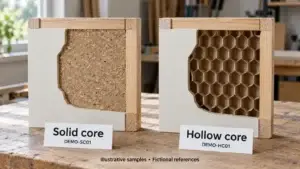
Solid wood interior doors are selected for their natural material, repairable finish and substantial feel, but the wood species alone does not define performance. A project-ready choice also needs an agreed leaf construction, dimensions, frame, finish, hardware, opening direction, environmental conditions and installation details.
Use this guide to compare solid-wood, engineered and solid-core interior door options without assuming that every heavy door is solid timber or that one material automatically delivers a fixed acoustic, thermal or service-life result.
Solid Wood, Solid Core and Veneered Doors
| Door description | What it may mean | What to verify |
|---|---|---|
| Solid wood | Stiles, rails, panels or other major components made from natural timber | Species, grade, jointing, lamination, moisture condition and permitted variation |
| Engineered wood | Laminated or composite components designed for stability and efficient material use | Core and face construction, edge details, finish system and intended use |
| Solid core | A heavy or dense core with wood, composite or mineral-based construction | Core type, face material, weight, hardware requirements and any declared rating |
| Veneered door | Natural wood veneer applied over a constructed core | Veneer species, cut, matching, substrate, edge treatment and finish sample |
These terms are not interchangeable. Ask the supplier to identify the complete leaf build-up instead of relying on a marketing label. The Window & Door Manufacturers Association notes that construction controls many performance attributes, while species, veneer selection and finish influence appearance.
Choose the Door Construction for the Opening
Stile-and-Rail and Panel Doors
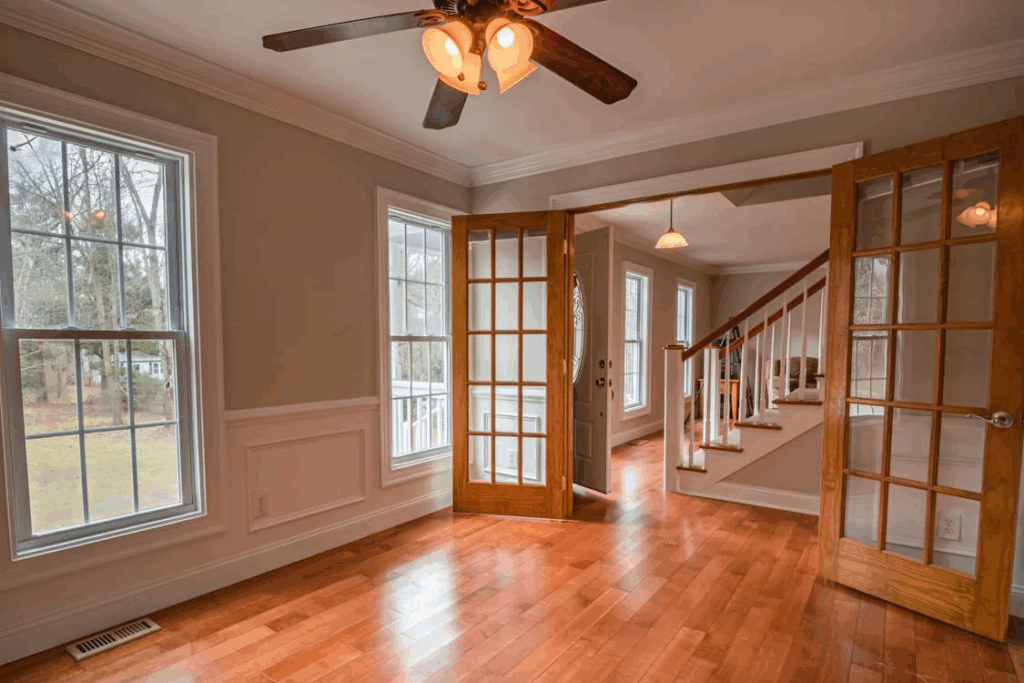
Stile-and-rail doors use vertical stiles and horizontal rails around solid, raised, flat or glass panels. They can suit traditional or contemporary interiors, but panel movement, jointing, glass retention and finishing details should be reviewed for the exact design.
Flush Doors
Flush doors provide a flat face and can use solid timber, veneer, engineered faces or other core systems. Confirm the core rather than assuming a flush appearance indicates solid wood. For a related overview, see the guide to wood interior doors.
Glass, French and Custom Doors
Glass openings change leaf weight, privacy, safety-glazing requirements and hardware loads. A custom size is possible only within the limits of the selected construction, glass, hinges and manufacturer. Coordinate the door schedule before assuming any size or shape is available.
Performance Depends on the Complete Door Assembly
- Acoustics: compare test data for the proposed door assembly when an acoustic target applies. Leaf mass alone does not define the installed result; perimeter gaps, seals, undercuts, frame and adjacent construction matter.
- Fire or smoke requirements: use a listed door, frame, hardware and installation system where required. Do not modify a rated assembly outside its approved scope.
- Movement and stability: species, construction, moisture exposure, storage, finishing and site conditions can affect warping, shrinking or swelling.
- Durability: confirm the intended traffic, hardware grade, edge protection, finish and maintenance requirements. Avoid universal lifespan or “will never warp” claims.
- Thermal performance: interior doors normally separate internal spaces. Any project-specific thermal requirement must be defined for the complete assembly.
Compare Wood Species and Finish
| Selection factor | Project question |
|---|---|
| Species and grade | Is the name exact, and what knots, color variation, sapwood or repairs are permitted? |
| Solid or laminated construction | Which components are solid, finger-jointed, laminated, veneered or engineered? |
| Veneer appearance | What cut, match and sequence are required across one door or a group of doors? |
| Finish | Is the door stained, clear-coated or painted, and what sheen and acceptable variation apply? |
| Environment | What humidity, ventilation, cleaning and wet-area exposure will the door experience? |
| Maintenance | What cleaning, inspection and touch-up guidance applies to the selected finish? |
Oak, walnut, mahogany, pine and other species differ in appearance, density, availability and cost, but a species name does not guarantee a fixed service life or property-value increase. Use representative samples and documented construction details for the proposed product.
Door Schedule, Frame and Hardware Coordination
Before quotation or production, coordinate the leaf with the structural opening, finished floor, wall thickness and hardware. The guide to standard interior door sizes can support early planning, but the approved door schedule and supplier drawings should control the final dimensions.
- Opening reference, room and quantity
- Leaf width, height, thickness and single- or double-leaf configuration
- Frame material, profile, jamb depth, architrave and wall build-up
- Handing, swing direction and clear opening requirement
- Hinge quantity and type based on leaf weight and project requirements
- Lockset, latch, lever, privacy function, closer, stop and other accessories
- Undercut, threshold, floor transition and ventilation requirement
- Glass type, privacy, safety requirement and bead detail when applicable
- Finish reference, sample approval and acceptable natural variation
- Required product data, drawings, reports and local approvals
How to Compare Interior Door Quotations
A lower unit price may exclude the frame, architrave, finish, hardware machining, locks, packaging or delivery. Compare every supplier against the same schedule and specification.
| Quotation item | Information to align |
|---|---|
| Door leaf | Construction, species or veneer, size, thickness, edge and finish |
| Frame and trim | Material, profile, jamb depth, finish and included components |
| Hardware | Brand or series, function, finish, quantity and installation preparation |
| Documentation | Shop drawings, samples, product data and required reports |
| Packing | Protection, room or opening labels and handling method |
| Commercial scope | Quantity, spare parts, delivery term, installation responsibility and exclusions |
George House Material can coordinate door schedules, quotations, finishes, hardware and project documentation around the available drawings. Review the project window and door systems and send the opening list through the project enquiry page.
Frequently Asked Questions
Is a solid-core door the same as a solid wood door?
Not necessarily. “Solid core” describes a dense core, while “solid wood” refers to natural-timber components. Request the complete leaf construction.
Do solid wood doors always provide better sound control?
No universal result applies. Acoustic performance depends on the tested leaf, frame, seals, undercut, hardware, adjacent wall and installation.
Can natural wood color and grain vary?
Yes. Define acceptable variation and approve representative samples. A small sample cannot show every natural difference across a complete door package.