By George House/26,Aug,2025
Decorative front doors combine an entry-door assembly with visible design features such as raised or recessed panels, carved details, glazing, grilles, color and statement hardware. The best option is not simply the most ornate. It is the design that fits the building elevation, opening size, exposure, privacy needs and required door performance.
Choose the appearance and the technical assembly together. A decorative leaf still needs a compatible frame, threshold, seals, hardware, glass build-up and finish system. Record those items in the schedule and shop drawings so quotations describe the same product.
Decorative Front Door Options at a Glance
| Design direction | Visual character | Important specification check |
|---|---|---|
| Paneled door | Recessed, raised or molded shadow lines | Panel profile, rail and stile proportions, face material and edge detail |
| Carved or routed door | Deep custom pattern or relief | Minimum thickness, pattern depth, sample and exposed-edge finish |
| Decorative glass | Clear, textured, frosted, colored or leaded appearance | Privacy, glass build-up, safety requirements, sealing and replacement access |
| Metal grille or screen | Layered pattern in front of glass or an opening | Material, finish, fixing, cleaning access and corrosion exposure |
| Minimal statement door | Large slab, grooves, pivot detail or bold pull | Leaf size, hardware capacity, alignment and weathering details |

Match the Door to the Building Elevation
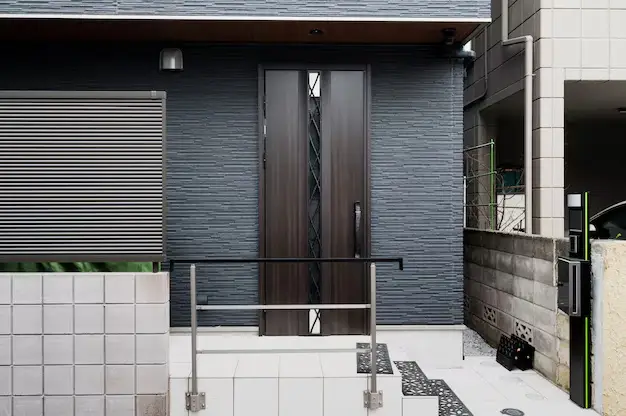
Begin with the proportions of the façade. Review the door against the porch, columns, windows, roof lines and wall finish rather than selecting it as an isolated product. Repeated rectangular panels can reinforce a formal elevation, while controlled vertical grooves or a simple glazed slot can suit a quieter contemporary façade.
The modern exterior door design guide gives additional composition references. Keep this page focused on decorative features and how they are specified, rather than treating every entrance style as the same product.
Define Panel, Carving and Surface Details
Panel Proportions
For paneled doors, state the number of panels, rail and stile widths, profile shape and whether moldings are integral or applied. A reference photo alone does not define depth, edge radius or the treatment at the lock stile. Use a dimensioned elevation and section.
Carved and Grooved Surfaces
Carved, routed or fluted faces need a representative sample. Confirm pattern scale, depth, corner transitions, substrate and finish build-up. Deep recesses may hold water or dust depending on exposure, so the approved detail should include drainage, cleaning access and coating coverage.
Select Decorative Glass for Light and Privacy
Glazing can introduce daylight while keeping the leaf visually lighter. Compare clear, acid-etched, patterned, laminated interlayer and colored options with an actual sample. Evaluate the view from both sides in daytime and at night; a glass that appears private in daylight may reveal silhouettes when the interior is lit.
Specify the complete glass make-up, spacer or cassette, edge cover, decorative grille and required safety classification for the project. Confirm whether a damaged unit can be replaced without replacing the entire leaf. Do not infer thermal, impact or security performance from appearance alone.
Choose the Material for the Exposure
Wood, metal, fiberglass and composite assemblies can all carry decorative designs, but their construction and maintenance differ. Review rain, sun, humidity, salt exposure, sheltered depth and interior conditions. Then request the exact leaf core, face, edge, frame and coating information.
Use the exterior door material comparison for exposure-specific tradeoffs. The selected material still needs project data and a maintenance plan; no material name by itself guarantees a service life.
Coordinate the Opening and Door Configuration
Confirm leaf size, frame outside size, rough opening, finished opening and required clear passage as separate dimensions. Decorative proportions often change when a door becomes wider, taller or part of a pair. A sidelight, transom or grille must align with the leaf and nearby façade lines.
For a common single-leaf reference, see the 36 × 80 exterior door guide. The final assembly should still be measured and scheduled for the specific project.
Treat Hardware and Security as an Assembly
A decorative pull, knocker, escutcheon or grille changes the appearance but must also fit the door construction. Coordinate lock case, backset, cylinder, hinges or pivot, closer, viewer and access-control preparation. Confirm that reinforcement and fasteners are compatible with the leaf and frame.
Security cannot be judged from a heavy-looking panel or grille. Review the tested or declared assembly data required by the project, together with glass retention, frame anchorage and hardware. Keep decorative decisions traceable to the approved hardware schedule.
Approve Color and Finish on a Representative Sample
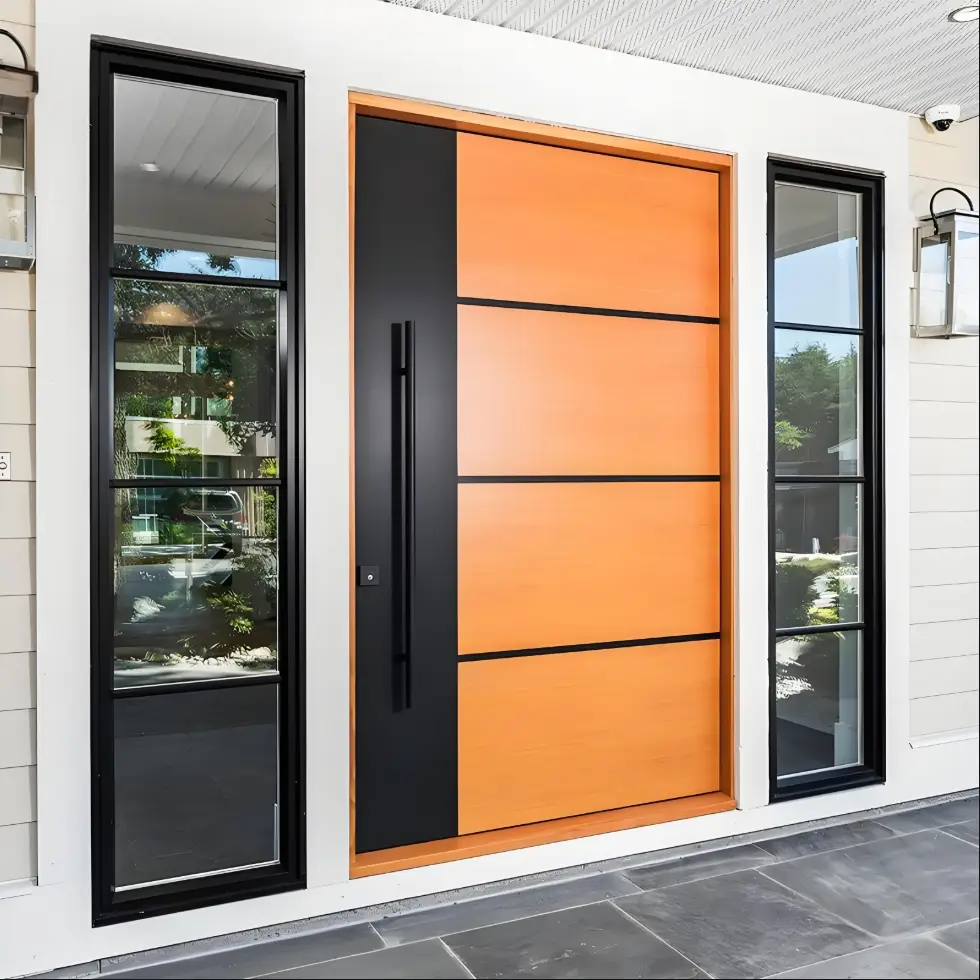
Review stain, paint or powder coating beside the wall, floor, glazing and hardware. Record color code, sheen, texture, primer, edge treatment and repair method. For a painted direction, the blue front door color guide shows how undertone and exposure affect sample approval.
Approve a sample that includes the actual substrate and decorative profile because color and sheen change across flat faces, grooves and moldings. If natural wood is used, define species, cut, grain matching, stain range and acceptable variation.
Decorative Front Door Submittal Checklist
- Door mark, location, handing and swing
- Leaf, frame, rough-opening and clear-opening dimensions
- Panel, carving, groove or grille elevation and sections
- Leaf core, faces, edges, frame and threshold materials
- Decorative glass sample and complete build-up
- Hardware set, preparation, reinforcement and finish
- Color, sheen, texture and representative finish sample
- Exposure, seals, drainage and project performance data
- Installation, protection, cleaning and maintenance requirements
Decorative Front Door FAQ
Can Decorative Door Glass Still Be Private?
It can provide different levels of visual obscurity, but privacy depends on pattern, lighting, viewing distance and glass build-up. Check a physical sample from both sides under realistic lighting.
What Is Needed for a Comparable Custom-Door Quote?
Issue the same dimensioned elevation, sections, material build-up, glass, hardware, finish and performance requirements to every supplier. A photo without those controls will produce quotations with different assumptions.
Finalize the Complete Entry Assembly
A successful decorative front door joins the visual concept to a measurable leaf, frame, glass, hardware and finish package. Use the door and window product hub to organize the complete opening schedule before requesting samples, shop drawings and final quotations.