Plywood is often a practical choice for cabinet boxes and supported shelves, while MDF is often preferred for smooth painted doors and routed profiles. The better material depends on the cabinet part. A kitchen can use plywood boxes with MDF fronts rather than choosing one board for every component.
For this plywood vs MDF cabinets comparison, plywood means veneer-core plywood unless stated otherwise. Decorative hardwood plywood can also have MDF, particleboard or combination cores, so a wood veneer face does not tell you what is inside the panel.
Compare the actual panel, construction, finish and installation scope before paying for an upgrade. Standard interior panels need protection from water, and the cabinet's joinery and hardware matter alongside its material.
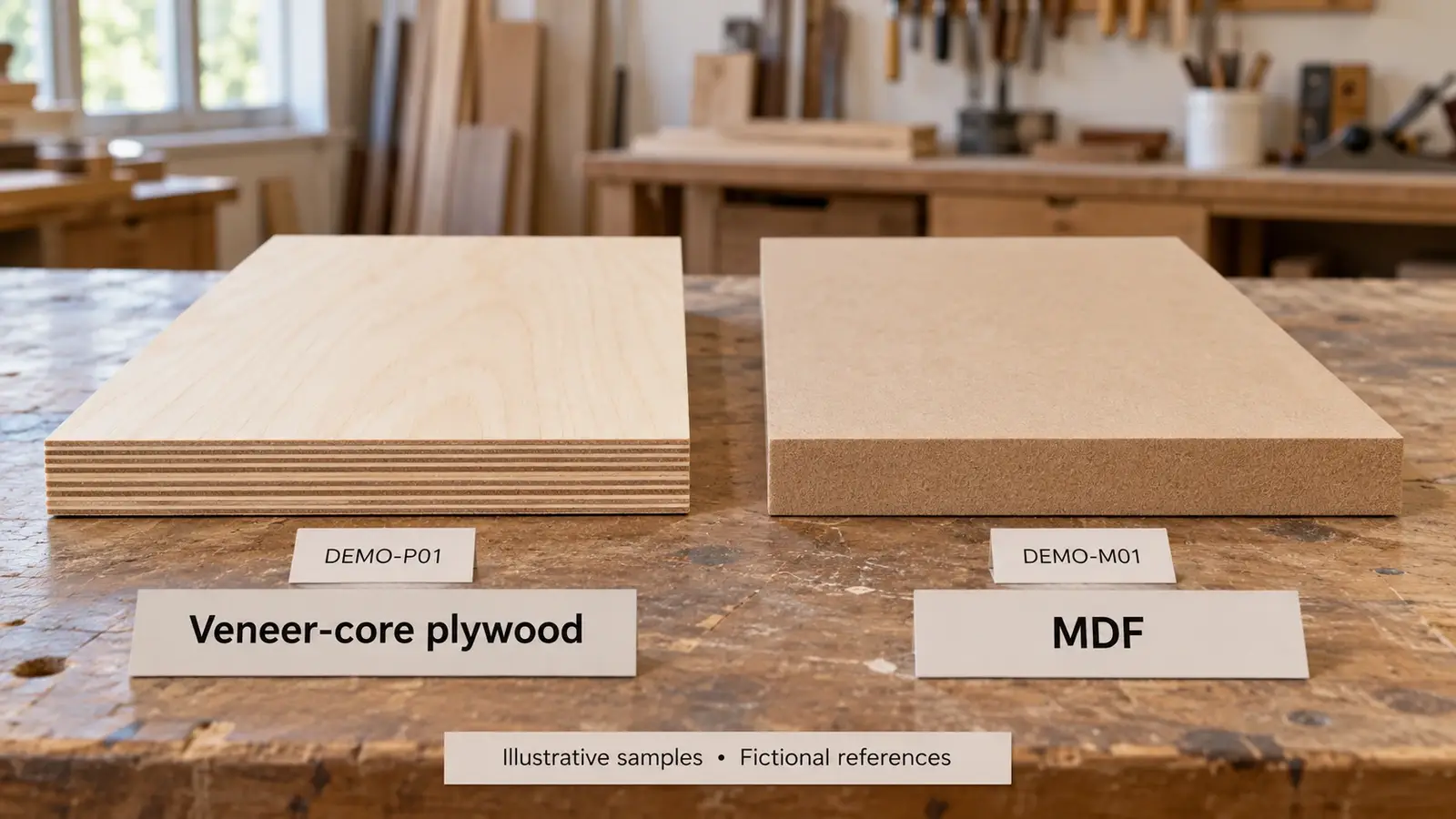
Plywood vs MDF Cabinets at a Glance
| What to compare | Veneer-core plywood | MDF |
|---|---|---|
| Construction | Bonded wood veneers, with grain directions arranged across layers | Wood fibers bonded with resin and pressed into a panel |
| Common cabinet uses | Boxes, partitions, supported shelves and drawer components | Painted doors, drawer fronts, routed profiles and selected supported panels |
| Painted appearance | Face grain, seams and edges can need more preparation | Smooth, uniform face; machined edges need suitable preparation and sealing |
| Woodgrain appearance | Decorative face veneer can be clear finished or stained as specified | Can receive a decorative veneer or other surface finish |
| Fasteners | Often offers useful screw holding; grade and fixing details still matter | Needs suitable fasteners, hole preparation and face or edge placement |
| Moisture | Water can affect the wood and bonds; grade and exposure conditions matter | Standard interior MDF is vulnerable to wetting; moisture-resistant grades have defined limits |
| Cost | Often costs more as a comparable raw panel | Often economical for painted components; finished cabinet prices vary |
Our custom kitchen cabinet and wardrobe guide explains how to coordinate the cabinet body, fronts, finishes and site interfaces as one package.
What Is the Difference Between Plywood and MDF
Veneer Core Plywood Uses Layers of Wood
Veneer-core plywood is built from bonded veneers, usually arranged with alternating grain directions. Its core species, veneer quality, thickness and manufacturing quality influence how the panel performs. The decorative face can be a different species from the inner layers.
Ask the supplier to identify the core construction and face grade separately. A higher ply count alone does not confirm a better cabinet, and a hardwood face does not mean every inner layer is the same hardwood.
MDF Uses Wood Fibers
MDF stands for medium-density fiberboard. It has a uniform fiber structure that can be machined into door profiles and finished with paint, veneer or laminate. Different grades are designed for different uses, including dry interiors and specified humid interior conditions.
MDF is different from particleboard, which uses larger wood particles. Do not accept a particleboard sample or test result as evidence of the proposed MDF product's performance.
The Surface Finish Is a Separate Choice
Paint, decorative veneer, laminate and other surface systems can conceal the substrate. Two similar cabinet doors may have different cores, while the same core can support several appearances.
Record both layers of the specification: the board underneath and the finish over it. A finished sample helps assess color and texture; a labeled section or product record identifies the substrate.
Which Material Is Better for Cabinet Boxes and Shelves
Cabinet Boxes Need Suitable Panels and Assembly
Veneer-core plywood is often selected for box sides, bottoms and partitions where stiffness, panel weight and fastening are important. MDF can also be used in suitable cabinet components when the panel grade, support and connections are designed for the application.
Check how the sides, bottom, back and fixing rails connect. A well-specified board cannot compensate for weak joints or an unsuitable wall attachment. The framed vs frameless cabinet comparison covers a separate construction decision that affects openings, hardware and installation.
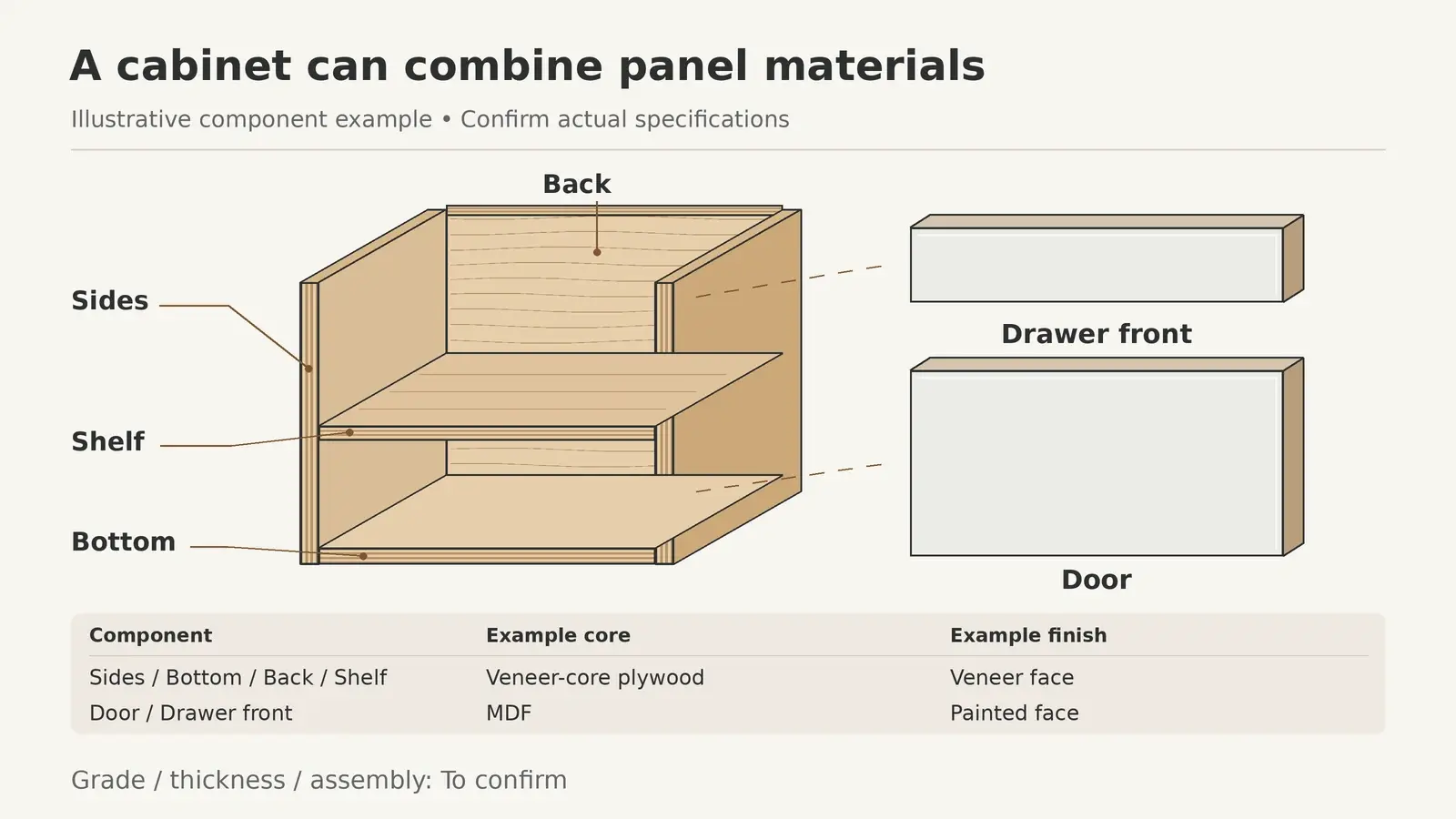
Shelf Span Matters as Much as Material
A shelf carrying plates across a wide cabinet opening needs a different review from a short shelf holding light items. Deflection depends on panel stiffness, thickness, clear span, load and support arrangement, including how the shelf behaves over time.
Ask the cabinet maker to confirm the proposed shelf loading and whether a center support, front stiffener or different panel is needed. MDF can work for appropriately supported shelving, but there is no universal safe span for all MDF or plywood shelves.
Drawer bottoms and backs also need their own specification. A thin panel captured in grooves behaves differently from a panel attached only at a few points; compare the complete detail before changing material or thickness.
Screws and Hinges Must Match the Board
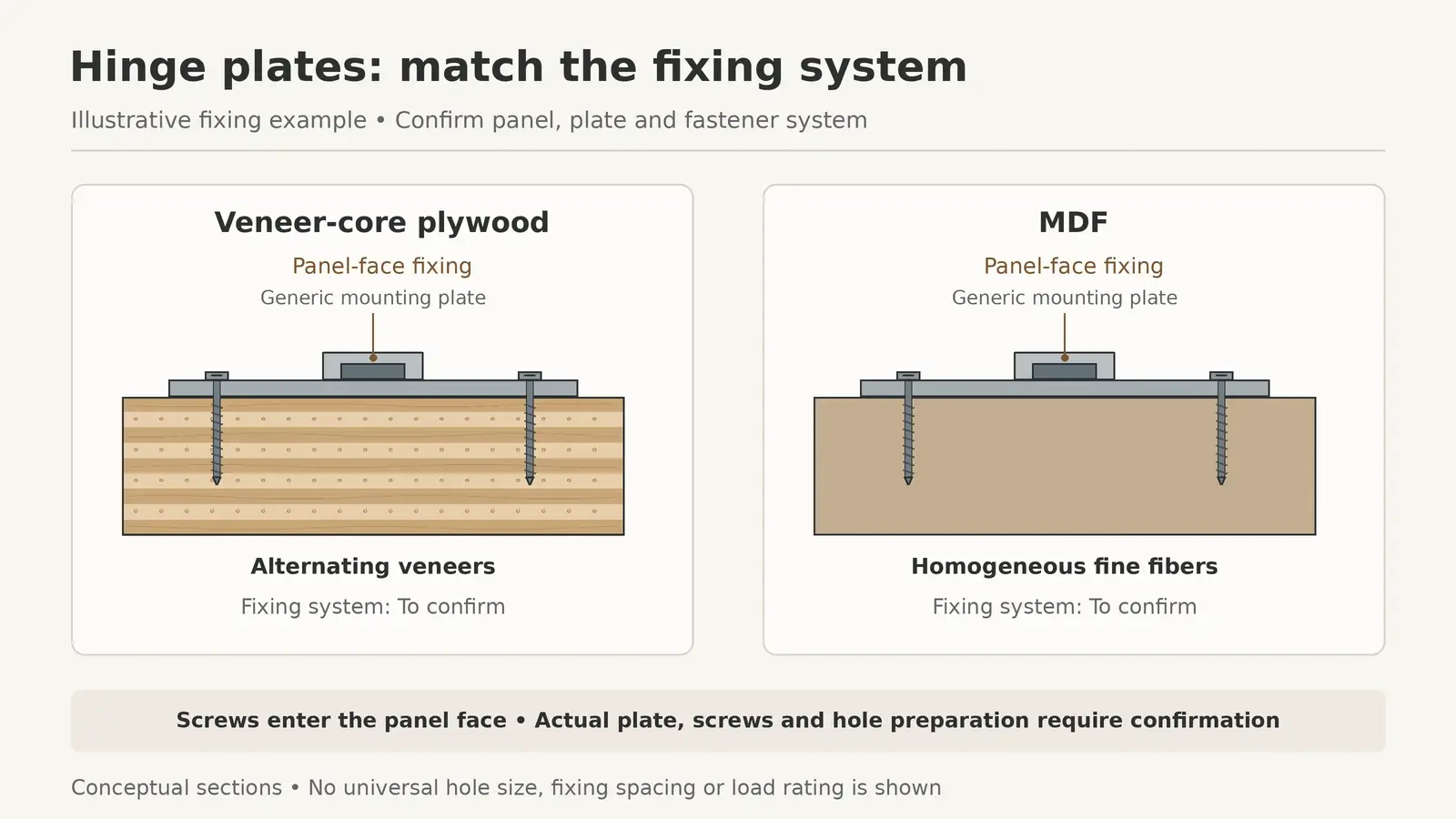
Veneer-core plywood generally offers favorable screw holding, but the fastener size, penetration, edge distance and panel quality still matter. MDF can hold cabinet hardware when the selected fixing system and preparation suit the board. It is inaccurate to say MDF cannot hold screws.
Ask for the hinge mounting and runner fixing details, especially on large or heavy doors. Face and edge fastening are different conditions. Over-tightening or repeated removal can damage the fixing location, and a panel screw-withdrawal test does not establish the capacity of a complete hinge assembly.
Use the cabinet hinge selection guide to record the hinge model, mounting arrangement, door weight and opening requirements.
Plywood vs MDF for Cabinet Doors
MDF Is Often Preferred for Painted Fronts
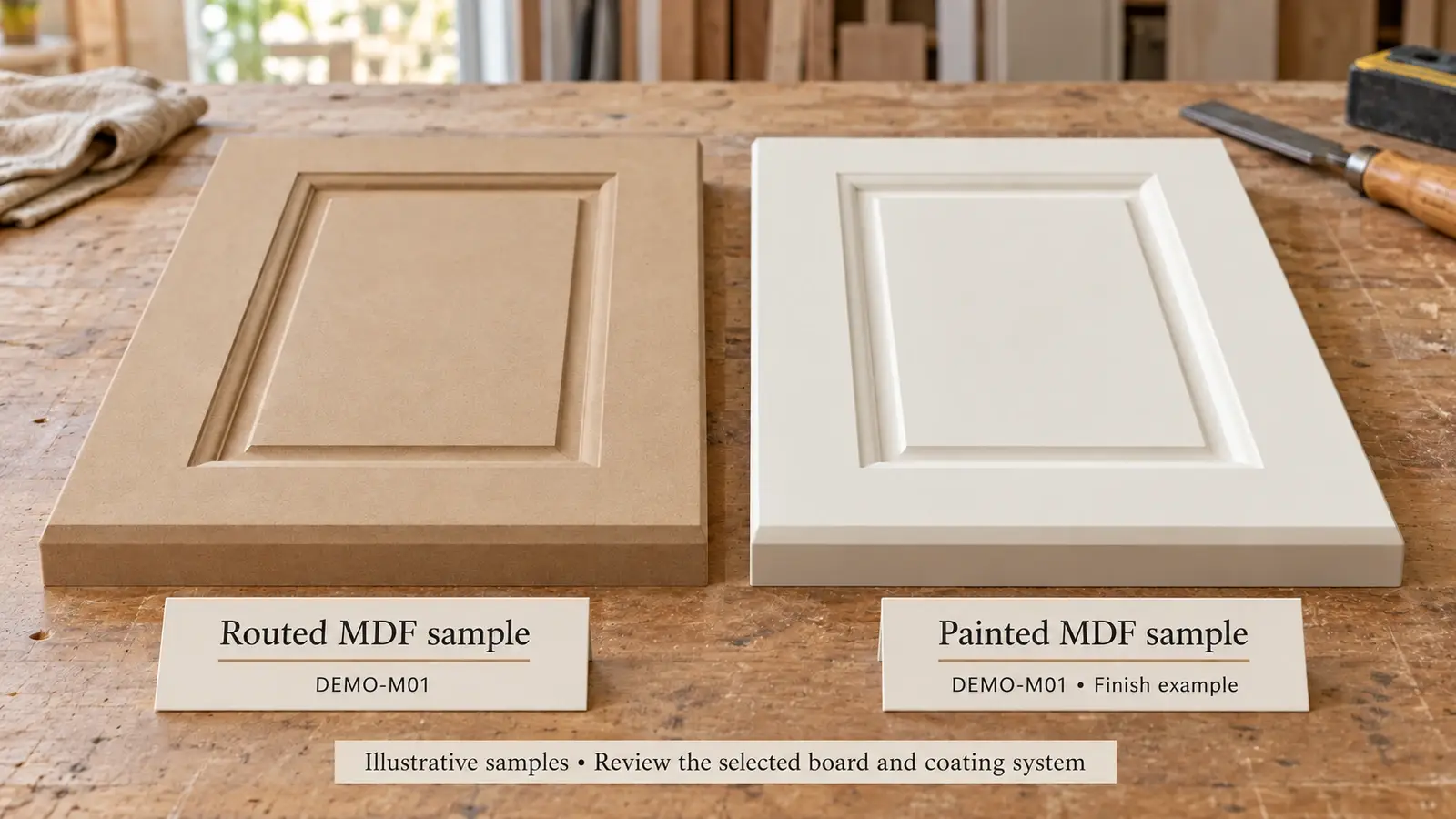
MDF's smooth face and consistent structure suit slab fronts and routed painted profiles. Its edges and machined areas need appropriate preparation, priming and sealing for an even finish. The coating system and workmanship determine much of the final appearance.
A one-piece routed MDF door and a five-piece door with a separate center panel are different constructions. Confirm the proposed arrangement, edge profile, door dimensions and hinge requirements. Our Shaker kitchen cabinet guide helps connect the door profile with its construction and sizing.
Plywood Can Suit a Visible Veneer Finish
A decorative plywood face can provide a natural woodgrain appearance. Review the veneer species, cut, matching, color variation and exposed edge treatment in a representative sample. A thin decorative veneer has limited sanding allowance, so check repair options before specifying refinishing later.
Plywood can also be painted, although grain, veneer joints or exposed edges may need additional preparation to meet the desired appearance. MDF can receive wood veneer too; specify the underlying core rather than assuming every woodgrain door is veneer-core plywood.
Neither substrate alone establishes scratch resistance. Compare the actual paint, veneer finish or laminate system and ask how chips or damaged edges can be repaired.
Moisture and Water Damage
Moisture Resistant Does Not Mean Waterproof
Standard interior MDF can swell when water enters exposed edges, holes or damaged areas. A moisture-resistant MDF grade is intended to perform better under its declared conditions, but that label does not make the finished cabinet waterproof. Specialist exterior products are a separate specification.
Plywood also needs a suitable grade and protection. Even where the adhesive bond is rated for moisture exposure, the wood and completed cabinet can still be affected by water. An adhesive designation alone does not establish a waterproof or decay-resistant cabinet assembly.
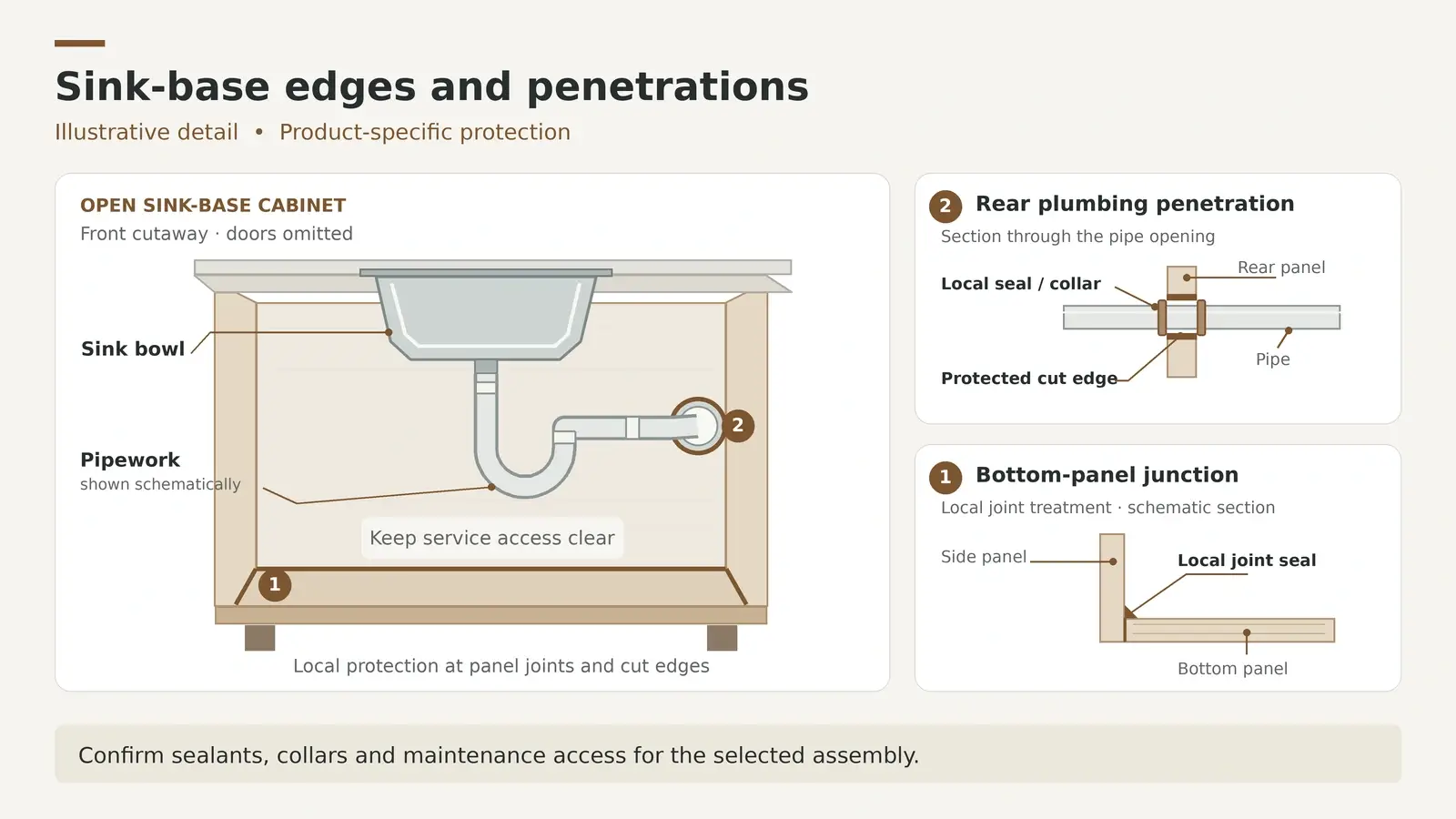
Protect Sink Bases and Appliance Interfaces
Specify edge sealing and protection around plumbing penetrations, cutouts, joints and vulnerable bottom edges. Coordinate sink connections, dishwasher instructions, service access and any tray or leak-detection provision included in the project.
Keep standing water away from the panels and repair leaks promptly. A tray is useful only within its actual coverage and detailing; it does not replace sound plumbing or make every cabinet joint watertight.
For a laundry or utility area, review the laundry cabinet design guide alongside the selected board's exposure limits. Frequent wetting calls for a system specifically suited to that condition.
Plywood vs MDF Cabinet Cost
Veneer-core plywood often costs more than standard MDF as a comparable raw panel, but the difference in finished cabinet price is project-specific. Higher-grade faces, special cores, moisture-resistant boards and decorative finishes change the comparison.
For painted fronts, MDF can be economical because it provides a consistent substrate for machining and finishing. The final cost still includes edge preparation, coating, hardware and labor. A complex painted MDF door can cost more than a simple plywood component.
Compare the same cabinet layout, quantities, dimensions, hardware and finish. Ask suppliers to identify which components change in a plywood upgrade, rather than accepting an unexplained price increase for the entire kitchen.
Use our kitchen cabinet quotation guide to compare the complete BOQ, including fillers, exposed panels, installation scope, worktops where included and delivery terms. No single percentage saving applies to every plywood and MDF cabinet package.
Emissions and Product Documentation
Both plywood and MDF should be selected with the required product documentation for the destination market. For a US project, ask the supplier to identify applicable TSCA Title VI compliance records and labeling for the supplied products; check any CARB Phase 2 claim against the relevant product evidence.
These requirements concern formaldehyde emission limits and related compliance obligations. They do not mean zero emissions or provide a complete indoor-air-quality guarantee. A no-added-formaldehyde statement describes a particular manufacturing claim and should not be rewritten as zero formaldehyde.
Keep the board manufacturer, product grade, relevant documentation and finished-cabinet references connected in the submission. Avoid choosing solely from broad labels such as eco-friendly plywood or non-toxic MDF.
Which Cabinet Material Should You Choose
Start with the job each part must perform:
- For box panels and loaded shelves, compare suitable veneer-core plywood with any proposed alternative using the actual thickness, span, support and connection details.
- For smooth painted doors and routed profiles, consider a suitable MDF grade with a documented finishing and hardware arrangement.
- For visible woodgrain, approve the veneer and finish sample, then confirm the core underneath it.
- Around sinks and other moisture-sensitive locations, review the board grade, edge protection and complete cabinet detail before approval.
A plywood box with MDF painted doors can be a sensible combination. The quoted specification should identify that combination clearly so the sample, drawings and supplied components agree.
For maintenance, use a soft cloth and cleaning products approved for the finish, then dry residual moisture promptly. A small finish chip may be repairable; a swollen panel or damaged hardware connection may need component replacement. Identify the cause before selecting the repair.
Cabinet Specification Checklist
Ask for materials by component, rather than relying on all-plywood or MDF cabinets as the complete description.
| Cabinet component | What to record before ordering |
|---|---|
| Box sides and partitions | Core construction, panel grade, thickness, surface, joints and fixing details |
| Bottoms and sink bases | Board and finish, edge protection, service penetrations and access |
| Shelves | Panel grade, thickness, clear span, intended load and support arrangement |
| Doors and drawer fronts | Substrate, construction, dimensions, profile, finish, edges and hardware |
| Backs and drawer bottoms | Material, thickness, attachment or groove detail and intended loading |
| Exposed panels and fillers | Core, decorative face, matching, finished edges and site allowances |
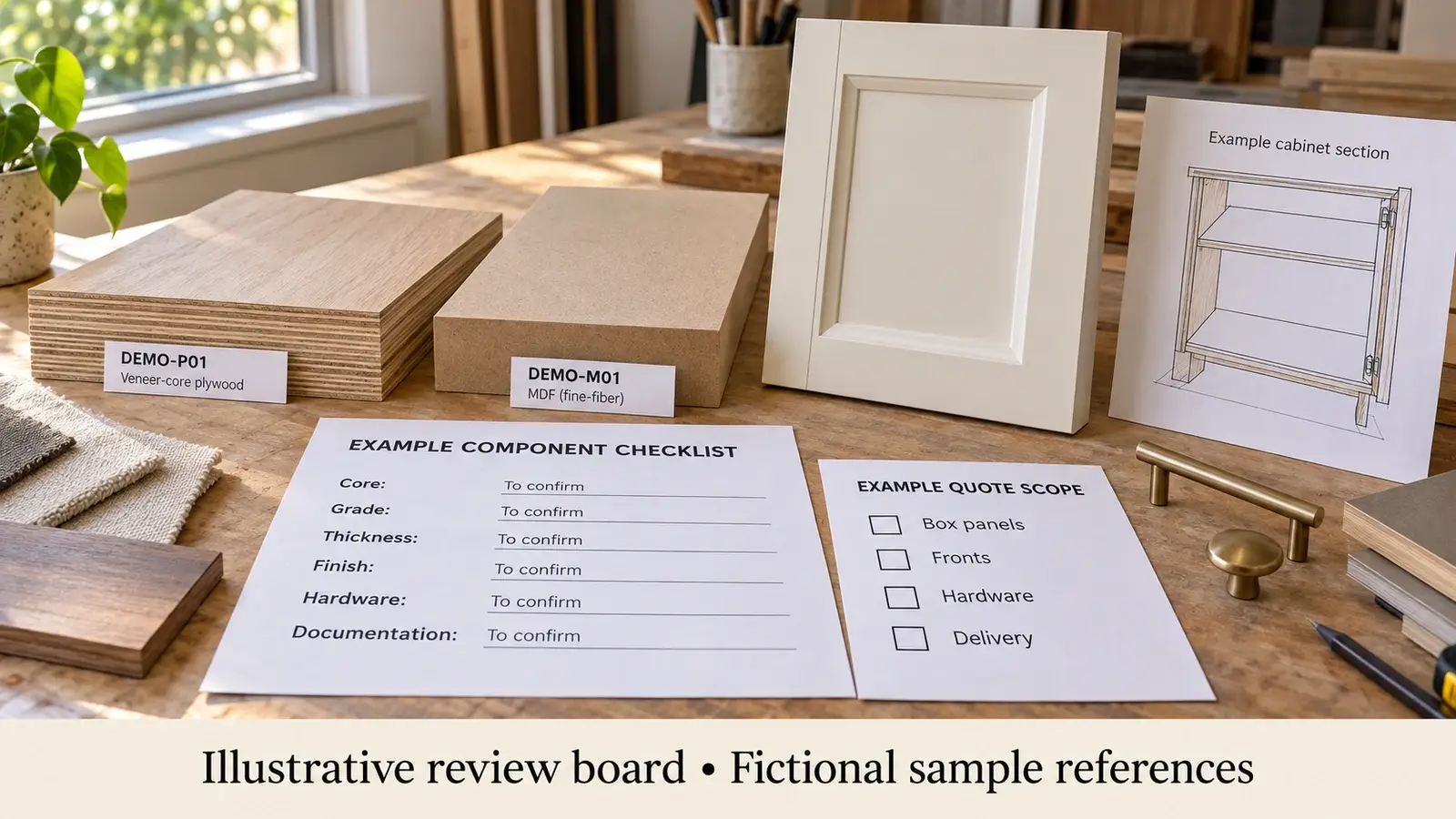
Connect these records to the room and cabinet references in a finish schedule. Approve a finished sample and relevant section details before production release, and keep any unresolved selections marked for review.
Request a Cabinet Material Comparison
Send George House Material your cabinet schedule or BOQ with the room plans, quantities, preferred finishes, hardware requirements and delivery location. Ask for plywood and MDF alternatives to be priced against the same component schedule, with the proposed panel grades and finishes identified.
Frequently Asked Questions
Is Plywood Better Than MDF for Kitchen Cabinets
Veneer-core plywood is often useful for boxes and supported shelves, while MDF is often preferred for painted fronts. Compare each component's purpose, board grade, construction and exposure conditions.
Is MDF the Same as Particleboard
No. MDF uses wood fibers; particleboard uses larger particles. Their grades, properties and fixing requirements should be checked separately.
Can You Use Plywood Boxes with MDF Doors
Yes. This combination can pair suitable box panels with smooth painted fronts. Confirm the material, thickness, finish and hardware requirements for each part.
Are MDF Cabinets Waterproof
Standard interior MDF is not waterproof. Moisture-resistant grades have specific limits and still require suitable protection. Check the exact product and complete cabinet assembly.
Does Plywood Hold Cabinet Screws Better
Veneer-core plywood generally offers useful screw holding, but performance depends on the panel and fixing detail. MDF can accept suitable hardware; distinguish face and edge fixing and follow the selected system's instructions.
Is MDF Cheaper Than Plywood for Cabinets
It often costs less as a standard raw panel, but the finished price depends on the grade, profile, coating, hardware and scope. Compare equivalent component schedules and complete quotations.
Which Material Is Better for Painted Cabinet Doors
MDF is often preferred for its smooth face and uniform machining. Plywood can also be painted with suitable preparation. Review a finished sample, including the edges and routed details.