By George House/06,Aug,2025
Shaker kitchen cabinets are identified by a recessed flat center panel framed by simple rails and stiles. The familiar outline can suit traditional, transitional and modern rooms, but the label alone does not define the door construction, proportions, finish quality or cabinet specification.
Compare the complete cabinet package: door and drawer fronts, box construction, exposed panels, finish, hardware, internal fittings, dimensions, appliance interfaces and approved samples. Small differences in rail width or sheen can change the finished appearance across a full kitchen.
Shaker Cabinet Decisions at a Glance
| Item | Options to compare | Approval record |
|---|---|---|
| Door construction | Five-piece timber, veneered, MDF or molded alternatives | Section or physical sample |
| Profile | Rail width, panel depth, edge detail and drawer-front treatment | Dimensioned elevation |
| Finish | Paint, stain, veneer, sheen and back-face finish | Representative sample |
| Hardware | Knob, pull, hinge, slide and internal accessory | Hardware schedule |
What Defines a Shaker Cabinet Door?
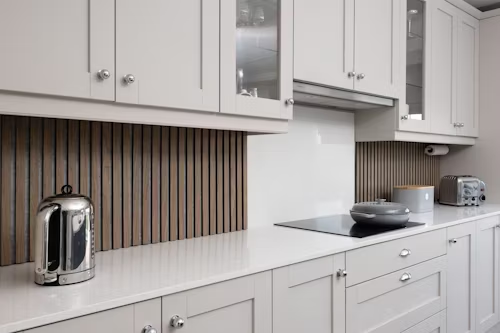
The basic form uses four frame members around a flat center panel. Modern interpretations may use slimmer rails, shallow recesses or one-piece routed fronts. The kitchen cabinet door style guide places Shaker fronts beside slab, raised-panel and other alternatives so the visual role remains clear.
Compare Door Construction, Not the Name Alone
Five-Piece Timber or Veneered Doors
A true five-piece door allows the center panel to be held within the frame. Specify timber species, moisture condition, grain direction, veneer matching, joints, panel movement and finish. Natural variation should be reviewed on samples large enough to represent the project.
Painted MDF and Routed Alternatives
MDF can provide a smooth painted surface and consistent routing, but the board grade, thickness, edge sealing, rear face and exposure condition still matter. One-piece routed doors do not have the same joints or movement pattern as five-piece doors. Record the approved construction instead of treating every painted Shaker door as identical.
Set Rail, Stile and Panel Proportions
Rail width should be coordinated across doors, drawers, tall units, appliance panels and narrow fillers. Very small fronts may need a simplified drawer treatment. Review elevations at the real module sizes so wide pantry doors and short drawers still belong to the same family.
Choose Color, Grain and Sheen Under Project Lighting
White is only one direction. Warm neutrals, darker colors and stained timber can all work with the Shaker profile. Compare undertone, gloss level, grain, edge appearance and cleaning expectations under the kitchen lighting. The kitchen cabinet color guide helps organize finish choices without claiming one color is universally best.
Pair Hardware with the Door Proportions
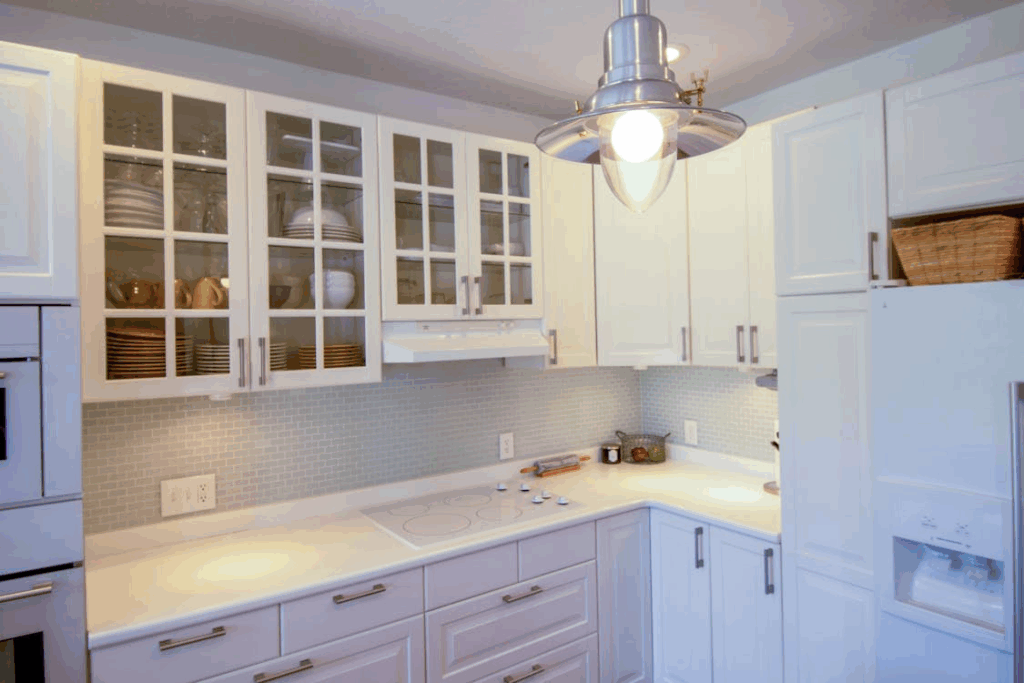
Knobs, pulls and handleless details change both appearance and operation. Confirm drilling centers, projection, finish, hinge opening, drawer-slide capacity and conflicts at corners. Hardware positions should align consistently across door and drawer fronts while remaining practical for the user.
Coordinate the Door Style with the Cabinet Layout
A door style cannot fix an unresolved layout. Confirm base, wall and tall cabinet dimensions, fillers, appliance clearances and finished ceiling conditions. Use the standard kitchen cabinet size guide as a planning reference, then adjust the modules to the actual room and equipment.
Compare Custom, Modular and Ready-to-Assemble Scope
Custom cabinets can resolve unusual dimensions and coordinated finishes, while modular or ready-to-assemble systems may simplify selection and delivery. Compare what is included: cabinet boxes, fronts, exposed panels, fillers, toe kicks, hinges, slides, handles, accessories, assembly, installation and packing. Price per linear unit is not comparable when the scope differs.
Write a Shaker Cabinet Specification
- Cabinet reference, room and quantity
- Box material, thickness, edge and interior finish
- Door construction, rail width, panel detail and thickness
- Paint, stain or veneer reference and sheen
- Exposed sides, fillers, end panels and appliance panels
- Hinge, slide, handle and internal-accessory schedule
- Countertop, appliance and service interfaces
- Required drawings, samples, mock-up and packing labels
Approve Representative Samples and a Typical Elevation
Approve a door sample showing the actual profile, construction and finish, not only a small color chip. For larger projects, review a typical cabinet elevation or mock-up with adjacent counter, backsplash and hardware. The custom kitchen design page explains the drawing and sample information used to coordinate a project package.
Shaker Kitchen Cabinet FAQ
Can Shaker Cabinets Work in a Modern Kitchen?
Yes. A narrower frame, restrained color, simple hardware and consistent appliance panels can create a modern direction. The decision should be confirmed on the actual elevation because proportion matters more than the style label.
Do Shaker Cabinets Cost More?
Cost depends on box and door construction, finish, hardware, accessories, dimensions, quantity and installation scope. The kitchen cabinet cost guide shows how to compare a normalized BOQ instead of using a universal price claim.
Finalize the Complete Cabinet Package
Well-specified Shaker kitchen cabinets combine a clear door profile with confirmed construction, dimensions, finish and hardware. Approve the representative sample and coordinated elevations before production so the repeated details remain consistent across the room.